Entering the world of smart contracts

Jun 1, 2017

One thing that’s interesting about yesterday’s Basic Attention Token sale is how quickly it went – $36M transacted in 30 sec.

Lots of people were surely disappointed as they attempted to buy into the token sale only to have their orders canceled for missing the sale window.

I haven’t nailed this down for certain, but I suspect that all of the successful buys in the token sale were programmatically executed through smart contracts, rather than by hand. The entire sale was tied to milestones in the Ethereum blockchain, making this possible. From the BAT sale site:

“The sale of BAT will begin at the time that mining commences on Ethereum block 3,798,640 and continue until the time that 156,250 Ether has been received or mining commences on Ethereum block 3,963,480, whichever is earlier. This is the “sale period.”

I honestly don’t know the mechanics of Ethereum well enough to really diagnose this, but my guess is that there were lots of buy contracts that were triggered to execute along side block 3,798,640.

I don’t think that we are quite prepared for what a world driven by “smart contracts” will feel like – despite the fact that we have had high frequency trading for years, smart contracts that auto-execute on blockchains will bring really fast transaction execution to lots more areas of life.

I am not sure that there’s anything wrong with that, just pointing out that it’s going to feel quite different than what we are used to today.

Mechanics of the token sale

May 31, 2017

In case you missed it, today Brave raised $36M for the Basic Attention Token. They had allocated 30 days for the token sale, but sold out of 1B BAT in 24 seconds.

The Basic Attention Token (BAT) ICO just raised 30 million dollars in 24 seconds. VC’s didn’t even have time to put on a sweater vest.
— briantobal (@briantobal) May 31, 2017

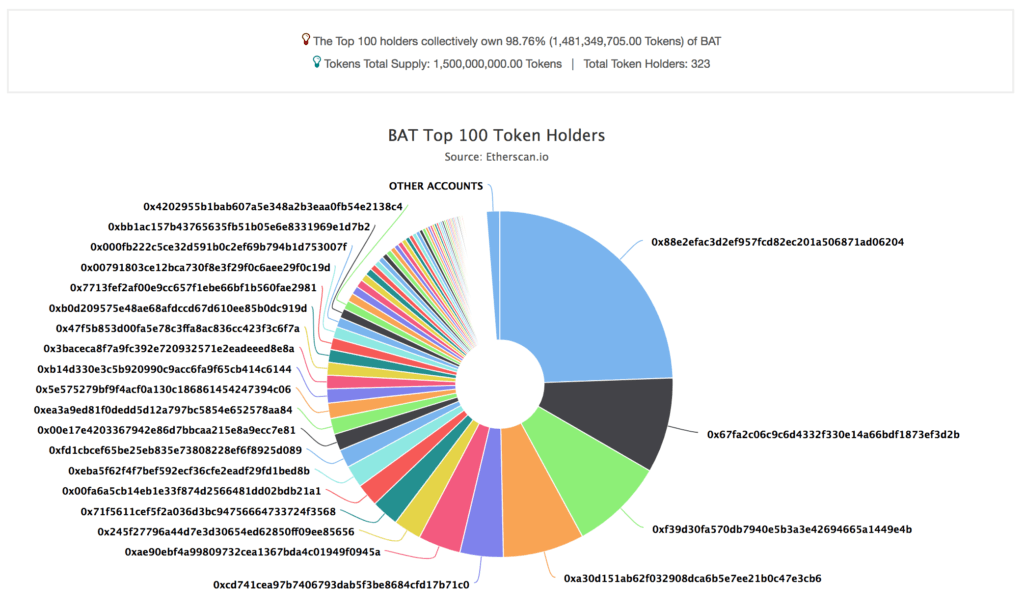
Clearly there is a lot of attention on this space right now – it’s no secret that there’s something going here. In this case, the reason the sale went so quickly is that there was a very small number of very large buyers — as of right now, the top 100 holders of BAT own 98.8% of the float:

Which raises the question, is this the right way to do things? In the idealized version of an open, public token sale, the idea would be to spread the ownership as much as possible — since tokens are really meant to be about use rather than simply speculation.

I suspect that we will see variations in the model that attempt to correct for this. Nick Tomaino suggests doing something akin to a private sale to large investors in advance of the public pre-sale:

best idea I’ve heard is from @ljxie: take indications from all, then raise a fixed amount giving % allocations based on those indications.
— Nick Tomaino (@NTmoney) May 31, 2017

While this doesn’t completely solve the problem, it does feel like an improvement over the BAT process — where large investors can participate without crowding out smaller investors and individual users.

Open source leadership vs. corporate leadership

May 30, 2017

As cryptocurrencies and blockchains have continued to gain steam (and attract capital), a common question in the air is, what type of leader does it take to be successful in this space?

A common variant on that question is: “will [leader] need a grownup in the room once they get ahold of all that money from the crowdsale?”

If it’s not already obvious, cryptocurrency development is open source development. The basic challenge in open source development is to get other technical people to adopt your technology, and to cultivate broad community support around it. The skills required are not just technical, but also political. Open source projects need to strike the right balance between direction, inclusivity, openness, commit rights & governance, etc — you are not only hoping to get people to use your technology, but to volunteer their time to maintain it. Nice trick!

If you look at some of the most successful open source projects, like WordPress, Ruby on Rails, MongoDB, jQuery, just to name a few — you’ll see a common pattern of buttery technology paired with savvy political leadership. The big political risk in any open source project is the fork — since the code is open, anyone can just take a copy and develop that in their own way, siphoning off attention and effort. So the main goal of the politics is to keep people onboard, rather than forking.

But sometimes, even the savvy political leadership part may not be necessary. Linus Torvalds, founder of Linux and Git, is notorious for his utter lack of sensitivity:

“Some people think I’m nice and are shocked when they find out different… I’m not a nice person, and I don’t care about you. I care about the technology and the kernel—that’s what’s important to me.”

So in some cases, (as in with Linux and Git) the technology can be so good that it can survive even caustic leadership.

The next question, then, is: but open source projects need a business model too, right?

WordPress needed WordPress.com (the hosted service) to supply the business model; Ruby on Rails needed Basecamp (saas); MongoDB followed the Red Hat model of enterprise support (and now hosted services), and Linux has the Linux Foundation (corporate donors) — in each case, you had to figure out a way to build a business on top of the open source foundation. Sometimes this works, but lots of of times it doesn’t.

What’s different about today’s crypto landscape is that the business model is built-in to the product, so there’s no longer a need to bolt-on a business model. So maybe we don’t need an adult in the room, at least not in the traditional sense of someone who knows how to “run a business” — making corporate deals, showing up to meetings in a suit, etc.

But, to add another twist: cryptocurrencies are like open source projects that are also central banks — they are both a tech platform and a monetary platform. So, take all of the politics inherent in open source projects (risk of fork, etc) and lever that up with strong financial interests tied to technology decisions: now you have the cryptocurrency ecosystem.

The two biggest examples from today are Bitcoin’s continued struggle to deal with its scaling issues, and Ethereum’s recent hard fork following the DAO hack. Bitcoin may be reaching consensus on scaling after several years, and it appears that Ethereum (under Vitalik’s direction) has recovered incredibly well after the hard fork.

Both of these have shown that you can build a multi-billion-dollar cryptocurrency platform with very little traditional business infrastructure, but that you will undoubtedly face not only the “regular” open source issues, but a new variant that is even more political and highly charged — that’s a tall order, but seems to be what’s required.
Regulating source code

May 29, 2017

As more areas of our economy become computerized and move online, more and more of what regulators need to understand will be in the source code.

For example, take the VW emissions scandal:

These days, cars are an order of magnitude more complex, making it easier for manufacturers to hide cheats among the 100 million lines of code that make up a modern, premium-class vehicle.
In 2015, regulators realized that diesel Volkswagens and Audis were emitting several times the legal limit of nitrogen oxides (NOx) during real-world driving tests. But one problem regulators confronted was that they couldn’t point to specific code that allowed the cars to do this. They could prove the symptom (high emissions on the road), but they didn’t have concrete evidence of the cause (code that circumvented US and EU standards).

Part of the challenge here is not just the volume of code, but the way it’s delivered: in the case of most consumer devices, code is compiled to binary, for competitive and copyright reasons. So, in the case of the VW scandal, researchers had to reverse-engineer the cheating, by looking at outputs and by studying firmware images.

By contrast, with cryptocurrencies and blockchains, everything is open source, by definition. If you’re curious about how the bitcoin, or ethereum, or tezos networks work, you can not only read the white papers, but you can examine the source code.

Because the value of cryptocurrency networks is embedded in the token, there is no longer a commercial incentive to obscure the source code — indeed, doing so would be detrimental to the value of the network, as no one would trust a system they can’t introspect.

This may seem like a minor detail now, but I suspect it will become an important differentiator over time, and we’ll begin to see widespread commercial and regulatory expectations for open source code over time.

Aligning purpose and strategy: Cloudflare goes nuclear on patent troll

May 26, 2017

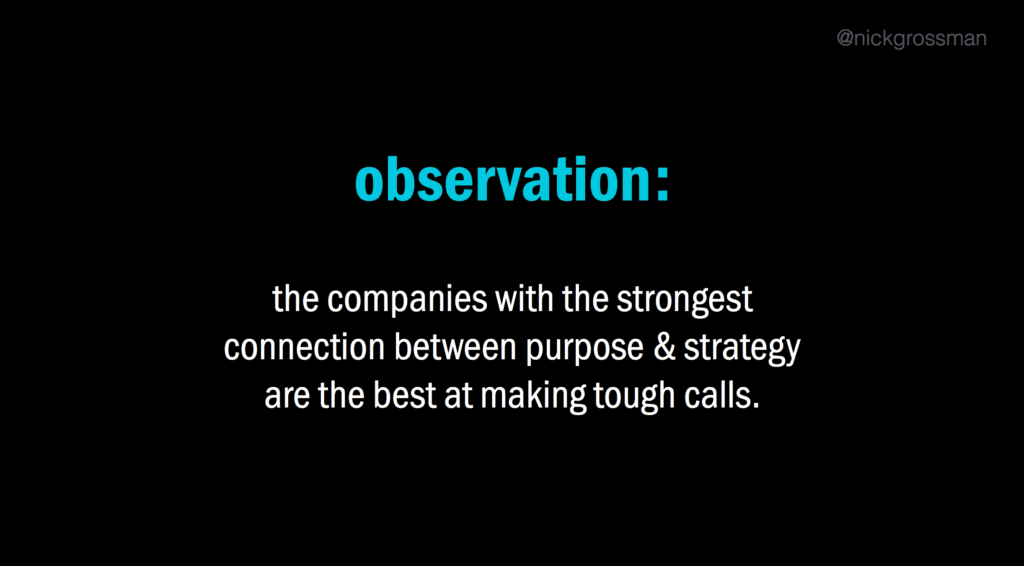
Last week, I was in Amsterdam at the Next Web conference, giving a talk about “Purpose, Mission and Strategy” — how companies can strengthen the connection between these to align efforts and make tough calls more easily (will post video when it comes online). From that talk:

The idea here being that there are tough, tough calls to be made every day, whether that’s what feature to prioritize, who to hire, what market to enter, what policies to enact, or whether to back down in the face of conflict or stand up and fight.

When I think about the connection between purpose, values and strategy, one of the companies that always stands out most brightly is Cloudflare. Anyone who operates a website or app probably knows Cloudflare but regular folks may not — they provide performance and security services for millions of websites, and currently handle over 10% of global internet traffic. Sitting in that privileged position, they must have a strong sense of their purpose and values, and strong backbone when it comes to living up to those.

This comes up in all kinds of ways. For example, it was recently revealed that Cloudflare had been fighting an FBI national security letter, under gag order since 2013, and even after the NSL was rescinded and no data was handed over, they continued to fight for the right to be transparent about the process:

“Early in the litigation, the FBI rescinded the NSL in July 2013 and withdrew the request for information. So no customer information was ever disclosed by Cloudflare pursuant to this NSL.
Even though the request for information was no longer at issue, the NSL’s gag order remained. For nearly four years, Cloudflare has pursued its legal rights to be transparent about this request despite the threat of criminal liability.”

I call that dedication to purpose and values. At the USV CEO summit a few weeks ago, Cloudflare CEO Matthew Prince made the comment that one way to “tell the story” of your company, both internally and externally, is to talk about things that you do or did, that others wouldn’t. In this case, the story is that Cloudflare is willing to stand up and fight, even when it’s well beyond their short-term corporate interests.

Today, this is playing out again in the context of patent trolls. Those outside the tech industry might not be aware of the detrimental impact of this activity on the tech ecosystem and startups in particular. In a nutshell, these Non-Practicing Entities (NPEs), aka “trolls”, will buy the rights to patents purely for the purpose of shaking down operating companies for settlements. The claims are almost always specious, and the strategy is to get startups to settle for just below the cost of litigating. Pay me to go away. It’s a huge problem: at best an expensive distraction and at worst a company-killing scenario.

That’s why I am so proud to see that Cloudflare, in the face of an assertion from a patent troll, has decided not to settle, but instead is standing up to fight. And they are not just doing the bare minimum, they are going fucking nuclear. Rather than do what many or most companies would do, just to get the troll to go away, they are standing up, not just for themselves, but for the whole ecosystem.

For more on the story, first read this, and then this. Cloudflare is not only going to litigate this case the full distance, but are also:

  • crowdfunding research to invalidate **all** of blackbirds patents
  • investigating blackbird’s business operations to expose some of the opaque and untoward inner-workings
  • filing ethics complaints in IL and MA regarding the unusual and likely unethical structure of blackbird (more detail in the posts)

To tie this back to purpose and mission, here is Matthew’s take on why they are digging in here:

“Cloudflare’s mission has always been to help build a better Internet. So it won’t be surprising to frequent readers of this blog that Cloudflare isn’t interested in a short term and narrow resolution of our own interests. We’re not going to reach a settlement that would pay tens of thousands of dollars to Blackbird to avoid millions in legal fees. That would only allow patent trolls to keep playing their game and preying upon other innovative companies that share our interest in making the Internet work better, especially newer and more vulnerable companies.”

Kudos to Cloudflare for standing up here and doing more than they need to. If more companies follow their lead, we stand a chance to make a dent in this issue.