The joy of fixing things up

Jun 24, 2017

I am on a plane right now, watching home renovation shows on HGTV, thinking about how much fun it is to fix things up.

Doing projects around the house (last year I built an exterior staircase and made new kitchen countertops, the year before that I built a mudroom), coding and buding apps, and working w founders to improve companies (what we so at USV) are all the same – starting out with something with promise, seeing the vision for the potential, and doing the work to fix it up.

It is just so satisfying, so fun, and so rewarding. It’s also scary and stressful, full of unknowns. Luckyfor me, both as a DIY home improver, and as a self-taught coder, and now as a yeoman venture capitalist, it’s easier than ever to learn from the outside.

I learned how to code by reading books, using open source code, and by benefiting from the questions and answers if countless others on stack overflow.I learned how to build and fix homes from a short stint working in construction after college, but now mostly by watching videos on YouTube.

I’m learning VC on the inside, but learned so much beforehand from the outside, reading books and blogs of the generous folks in the industry (here’s looking at you, Brad and Fred)

But anyway, point is just that making things, and fixing things, is just the best. It’s my favorite thing to do, and what I plan to do in as many ways as I can, for as long as I can.

Getting in over your head

Jun 22, 2017

I was out last night with some of the little league coach dads, and we got to talking about whether it’s better for our kids to be bumped up a level (but be at the lower end of skills/experience) or stay back a level and have a chance to really excel. The consensus was that you want the kids to stretch, and learn from people who are better than them, but not to take it so far that they feel demoralized and tiny.

It got me thinking back to the time in first grade where I got bumped up to the higher math group, but then couldn’t hack it and got bumped back down. I can still see the workbook where I doodled all over the pages because it was easier to do that than to engage in the work.

And then I thought about the time I took intro to computer science my freshman year at Stanford (never having done any coding before) and feeling so left behind by the rockstar kids in the class, who seemed as though they’d been coding since they were six. I dropped the class. That one really stuck with me — I really enjoyed coding, but didn’t stick with it (at that moment in time — I came back to it later). But for years, I regretted not giving it a better shot.

Then, 5-1/2 years ago, I was out to lunch with Brad Burnham from USV, intending to pitch him on funding one of our spin-out projects at OpenPlans, and he asked if I wanted to come and do some work with them. The area of work that Brad wanted to focus on at that time (tech policy) was something I had touched on during my time at OpenPlans, but I was by no means an expert. And stepping up into a big name VC firm was exciting but intimidating.

I remember going home and weighing a bunch of options — at that time, things were changing at OpenPlans, and there was one opportunity there, another opportunity at another tech company, and then a very unformed (and kind of terrifying) opportunity with USV. As I thought about all of that, I remember thinking that going in the USV direction was definitely the most interesting, but it would mean getting in way over my head.

I obviously decided to go that route, and it has been a steep and amazing learning curve ever since (starting with the policy work, then getting into everything we do at USV). And I think I have learned a whole lot from people who have been doing this for decades. I’m glad I made that decision — and more importantly that I stuck with it, even though there have been plenty of times when I doubted whether I could do it.

I think this is particularly relevant in the startup world, where things are changing constantly, and there’s plenty of opportunity to step up into bigger roles as things change. My colleague Bethany wrote about this last week — how a startup is almost like a completely different organism every six months, with different holes to fill and different ways to contribute. It can be scary. I remember back at OpenPlans, when I went from managing a small product basically by myself, to inheriting a 20-person engineering team, and then 2 years later running a diverse division of the company. The first time I had to decide someone’s salary I was like, oh shit, and the first time we did a restructuring, I was like really oh shit.

Going through all of this, the earlier failures that continue to haunt me (and believe me, there are others) have continued to serve a pretty good purpose: reminding me, when things get hard or intimidating, or when doubt creeps in, that I want to stand up though it and learn from the situation, rather than shrink from it.

I hope we can teach our boys (and girls) to do the same.
For web platforms considering a token strategy: cryptocurrency vs. dollars?

Jun 15, 2017

A lot of founders / teams have been asking if they should be adopting a cryptocurrency strategy. This is understandable given the frenzy of fundraising recently and the ongoing dialogue about the potential for cryptocurrencies as an alternative business model for web platforms.

As “traditional” web & mobile platforms explore this option, there are a few important considerations (esp given the risk in this model):

1) What is the advantage of using a cryptocurrency instead of traditional money? Answers could be: programmability, international exchange, earnability, etc.

2) Could I use an existing cryptocurrency (e.g., zCash) instead of launching my own?

3) From a revenue / value perspective, is there a model for value creation independent of funds that could be raised in an ICO? e.g., are you just looking to raise short-term funds an alternate to an equity round, or is there a real value theory of cryptocurrency running inside your application?

4) Could you imagine such a cryptocurrency spanning beyond the borders of your own application? Generally speaking, if there’s a more use = more value theory (i.e., “fat protocols“), there’s an incentive to go broad to increase use.

5) What is the model for internal economics around the cryptocurrency? E.g., how would people earn it, and how would they spend it, within the ecosystem?

I’ll follow up with more on these in a future post, in particular #5, as I believe that is the most fundamental question.

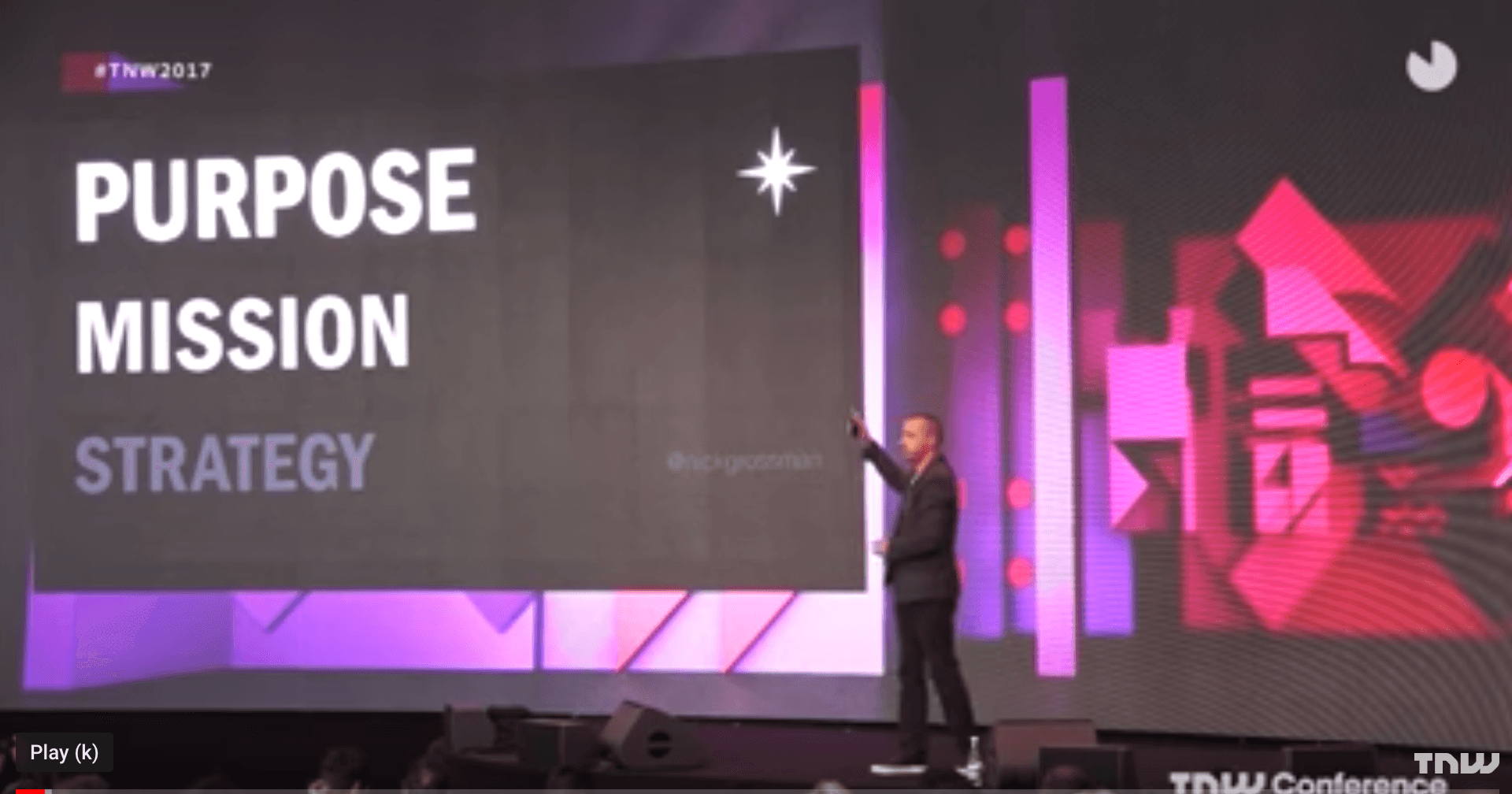
The Next Web Amsterdam: Purpose, Mission & Strategy

Jun 7, 2017

Last month, I went to the (most beautiful city in the world) Amsterdam, to speak at The Next Web Conference. I did two talks, one at a sub-event focused on tech & social issues, on the topic of Data & Power, which I will post when it comes online, and a main stage talk on the topic of Purpose, Mission & Strategy — how to connect the three to align efforts within a company.

In the talk, I take examples from throughout our portfolio of how leaders define and communicate their purpose, within their organizations and externally, and then use that to make tough strategic calls. For example, I wrote last week about how Cloudflare is fighting hard against patent trolls, and how deciding to do that is not just a narrow corporate decision, but a tough strategic call that draws from the company’s sense of purpose and mission (frankly, I explain that example much better in the post than I did in the talk).

For another example, Brian Armstrong from Coinbase just posted their long-term strategy yesterday, and this another example I discuss in the talk. I’ve been impressed by how Coinbase’s efforts are aligned internally, and by the way Brian has connected the company’s purpose and the strategy.

You can watch the whole video (about 25 min) here:

And you can see the slides here:

This was my first time giving this talk, so of course there are things I’d tune for take two. I would in particular like to thank the awesome folks at Praytell who hosted me for a dry run of the talk and gave me great feedback and questions. And of course I would like to thank all of the USV leaders who, over the years, have shared their stories, which were the foundation of the talk.

A little better every day

Jun 3, 2017

I just got done coaching my son’s baseball practice. It has been amazing to watch this group of 7 and 8 year olds improve over the course of the season – learning the fundamentals and now starting to make some pretty great plays.

I had a great baseball coach as a kid. I’ll never forget the feeling of having the coach show us the right way to throw, and how weird it felt at first, and then how normal it felt eventually. He said: “practice doesn’t make perfect. Perfect practice makes perfect”, and that has always stuck with me.

It is the idea in Angela Duckworth’s book, Grit, that sustained, directed effort is the thing that gets people from good to great. Making little steps every day, targeted to improve the weaknesses you want to work on.

At the USV CEO summit a few weeks ago, the CEO of a very large, successful and fast growing company said something to the effect of “we have always reminded ourselves to have a big vision, but to take small steps to get there” (I am butchering the language but you get the idea.

It really struck me because it is easy to think that for companies to grow and be great and big, every improvement has to be a giant, immediate leap. That’s a hard mindset to shake, because it’s just so intuitive, and there is also so much pressure to grow and succeed.

But really, all you can do is focus on getting a little better every day. And over time, each of those improvements is part of the overall improvement, which compounds as it grows.

I think it can be hard to give yourself the space, and have the patience, to just focus on making small improvements every day. But it feels to me like this is a very healthy and productive mindset if you can find it.