Cryptocurrenices: the native business model of attention

May 25, 2017

There has been lots of attention this week on cryptocurrencies and blockchains, what with Consensus conf and the Token Summit and lots of related announcements.

And with like lots of new things (thinking back to Twitter circa 2010) I find myself spending a lot of time explaining to people what blockchains and cryptocurrencies are, and why we think they’re interesting.

It has taken us years to peel away layers of understanding around Bitcoin and blockchains — see “Bitcoin as Protocol” (2013), “The blockchain as verified public timestamps” (2015), “The Golden Age of Open Protocols” (2016), “Fat Protocols” (2016). We’ve been chewing on this idea that cryptocurrencies aren’t just digital money, they’re something else — they’re a new way of storing and verifying data, a new way of building tech platforms, and a new way of monetizing activity on the web.

One way I’ve been thinking about it recently is that cryptocurrencies are the native business model for open source and open data. I come from a background working in open data, open source, and open standards — mostly in the context of cities and governments. I spent the better part of 2008-2011 working to advance standards like GTFS and Open311, and searching for the super-forces that would drive adoption (see Where Do Web Standards Come From?). The big takeaway from that time was that standards don’t propagate themselves — you need some sort of major driver to pull them into market (in the case of GTFS it was Google Maps).

What we have now learned from cryptocurrencies and blockchains is that they can provide that driver. By creating an economic incentive — the cryptocurrency or token — to create a shared open data asset, we now have powerful driver for open data, interoperable through open standards. This is the point of Joel’s Fat Protocols piece — that with cryptocurrencies and blockchains, we can now monetize the underlying token and let the data be open, rather than controlling the data and monetizing access. This is a really big deal.

Take that a step further, we can now re-think how we build “platforms”. Think social networks like Twitter, who have historically been forced to close down their APIs in order to keep attention within their own ecosystem, rather than let it “leak” to third parties. Blockchains and cryptocurrencies offer an alternative here as well — by monetizing through an underlying cryptocurrency, we can now afford to be “open” when it comes to platform interoperability. As much as I dislike the Rare Pepe project because of its racist roots, one thing stands out: the way it’s open and interoperable by default. From this article describing the project:

Interoperability
Finally, the potential of rarepepe model doesn’t end with simple digital asset collection and trading. What’s even more remarkable about this token model is that third party developers or projects can bring external value and use cases to pepe tokens thanks to their open and permissionless nature.
Interoperability and permissionless nature is what differentiates tokens on the blockchain from closed proprietary systems or private blockchains whose essences are control and permissioned. Whether you like it or not, as long as it’s on an open and public blockchain people will create unexpected use cases and synergies that even token issuers cannot imagine sometimes. In my opinion, this is the biggest advantage of using tokens on a public blockchain and this type of cross collaboration has started to emerge already with Pepe.
For example. the Rarepepeparty project is developing a trading card game with some RPG element utilizing rarepepe tokens and user created memes. If you own those cards in your wallet and prove its ownership, you will be able to play your dank pepecards within the game.”

So what we have here is now a new business model for platforms. Whereas in the past, you had to lock down your platform in order to control the flow of eyeballs, either for transactional revenue or ad dollars, now the incentives are flipped — the more people who use it and build on it, the better, so let it be open.

So really, what we have now is a new business model for attention. One where we can be open to share attention with others, as long as we are bound by an underlying cryptocurrency or token. This is relevant to any platform or network with an advertising-based business model. As everyone knows, it’s hard to make money in the ad business if you’re not Facebook or Google, so it’s exciting to think that maybe you don’t need to be in the ad business to build a successful and sustainable social platform. This is what Kik is pioneering today with the launch of the Kin token, and if this works I suspect it will be a model that many ad-supported networks follow.
The Service Recovery Paradox

Mar 17, 2017

I’m writing this from a plane. I’ve been in the air for an hour and everything is fine, but for a few minutes before the flight, things weren’t fine. At roughly the time we were supposed to board (on an already late in the evening flight), the gate attendant came over the mic to announce that there was a staffing problem on our flight, and they were “beginning the process” to get it sorted out. He’d get back to us when he had an update. Huge groan across the hot and overcrowded gate area.

Then, maybe two minutes later, he gets back on the mic and says: “update on this — we’ve got our staffing problem resolved, thanks to Dave!” (and points to our new flight attendant Dave, who is standing next to him, ready to board the plane, grinning).

The room erupted in applause, interspersed with an extended round of “yeah Dave!” and “attaboy Dave!”. Smiles everywhere. Excitement. Good mirth. Everyone was not only relieved that our flight wasn’t terribly delayed, but they were more happy than if there had been no problem at all.

This is an (admittedly trivial) example of one of my all-time favorite phenomena, the Service Recovery Paradox, defined on wikipedia as: “a situation in which a customer thinks more highly of a company after the company has corrected a problem with their service, compared to how he or she would regard the company if non-faulty service had been provided.” Amusingly, the first example on wikipedia is a canceled flight.

And it held true in this case. After the first announcement, the attitude in the room was “dammit Jetblue, get your shit together”. And after the second, it was “love Jetblue because they have Dave!”. But in all seriousness, it wasn’t the swift recovery that mattered, it was the way the team at the gate handled it.

I think about this all the time, and it just underscores how important it is not just to prevent bad things from happening, but being ready to respond really well when they do. Whether that’s a hack, a bug, or just a plain old mistake. And it’s a great reminder that when a problem does happen, your work isn’t over; it’s just beginning. And that you have the chance to not only fix it, but to make things better than they were.

Complicity

Mar 8, 2017

I had an interesting experience today. As I was in the air on my way to San Francisco, I got a text from my Airbnb host saying that they had made a mistake and accidentally double-booked my room. I ended up taking their offer to cancel and booked a hotel room (at a steep increase in price). Then they asked if I would call Airbnb and say the cancellation was mutual, so that they wouldn’t get “dinged”. I didn’t like that idea.

Then, after I asked for a regular refund, and after some more back and forth, it appeared there was some confusion between my host and her assistant, and the room actually was available, and no I could not have a cancellation. This was a problem because my new room was already book, with no way to cancel without paying a big penalty.

The whole situation felt fishy, scammy. I looked back in the reviews of the apartment, and I noticed a few other last minute cancellations (I hadn’t looked super closely the first time). Texting with my colleague Bethany about it, we talked about the importance of writing a real review of the situation and processing a formal complaint through Airbnb. I thought: it’s so great that Airbnb is there to handle disputes like this, to be the sheriff when people go off the rails and do shady stuff.

I made the point that I needed a cancellation, and finally the host asked if instead of a formal cancellation, could I accept a paypal refund. I thought about this, and my first response was: no way — I want this to go on the official record so this kind of shady behavior can’t continue.

Then, I remembered earlier in our conversations, when I first booked the apartment. In the instructions, the host suggested I tell the front desk I was a “friend”, visiting (because, of course Airbnb isn’t allowed in that building). In my mind, I played along just fine with that, happy to be complicit in our little ruse — because the apartment looked great, and what’s the big deal anyway.

So, fast forward to our refund situation: now I no longer feel like I have any moral high ground to demand a formal close out — in my mind, I was complicit in the shadiness when I was cool with fooling the apartment building. How is that any different than agreeing to sidestep the Airbnb platform rules?

Just goes to show how difficult it is to build a real trusted environment. On the one hand, Airbnb does a fantastic job building trust and accountability using its platform. On the other hand, a wink and a nod on one end of the platform (renting an apartment where I shouldn’t) makes it hard to really stand up for the rules on the other end (reviewing the host for bad behavior).

Our chat in the Airbnb app ended with the host saying “U r nice person.” Not sure how I feel about that.

Flexing the platform for good

Mar 6, 2017

Over the past few weeks, I’ve been touching base with many companies and individuals in the tech sector to understand how they are reacting to the current political environment.

Every company and community (of users, customers) is different, with its own sensitivities, priorities, and goals. So it’s been really interesting to understand the very wide range of contexts and positions that companies are taking. For instance, many tech companies have employee bases who skew left-leaning, but may also have user and customer communities that are very diverse (especially across red and blue states). And even those companies who may skew left internally, they are generally sensitive not to alienate any Trump supporters on staff. So it’s complicated.

As the white house continues to issues executive orders on issues like immigration that hit tech companies directly, and as issues like transgender rights — that are outside the pocketbook interests but may intersect with a company or community’s values — come up, it feels as though companies are going to continue to be under pressure to take public stands.

As this happens, one of the things I’ve been noticing is that some of the best ways to engage on issues are native to the platform — meaning, rather than simply signing a letter, there can be more creative, powerful, and ultimately more straightforward ways to get involved.

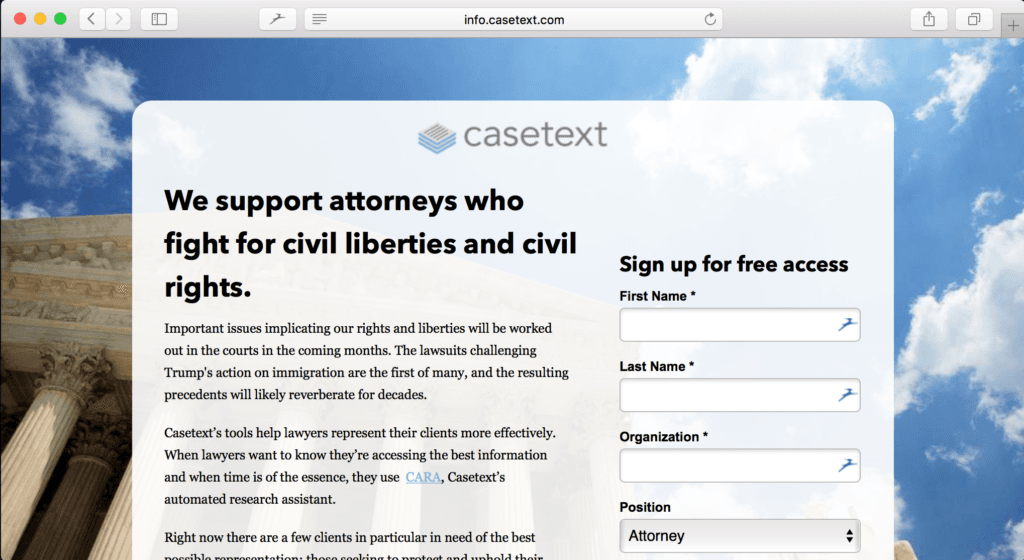
For example, our portfolio company Casetext, which builds a legal research tool that they sell to law firms, has offered free access to their platform for any lawyer working on civil liberties and civil rights issues:

What’s so beautiful about this is that it doesn’t involve taking a complicated political stand that runs the risk of alienating users or customers. Instead, it is completely aligned with the core mission of the company and value proposition of the platform. This reminiscent of Airbnb’s offer to host refugees for free, which is similarly elegant and platform-aligned.

Further, a risk in the current political environment is “outrage fatigue” — the rapid fire nature of policy today is exhausting, and individuals are feeling buffeted by the constant news onslaught. So efforts like these are a nice counterforce, in the sense that they are proactive, constructive, and provide a longer-term basis of support for issues that matter.

I’m on the lookout for more opportunities like these.

Cycles

Mar 2, 2017

It’s clear that right now we are in a moment of upheaval and turbulence, that seems to have come upon us very quickly. Pretty much everyone I know has been wrestling to unpack this for the past several months.

I’ve been trying my best to understand the worldview of Steve Bannon, who is clearly an ideological center of this administration. For those who’ve also been on that quest, I recommend an article from this week’s Washington Post, Where did Steve Bannon get his worldview? From my book, written by historian Neil Howe. Howe, along with co-author William Strauss, in 1997 published The Fourth Turning: An American Prophecy – What the Cycles of History Tell Us About America’s Next Rendezvous with Destiny. This book has been a major influence on Bannon, and the gist is that history is neither linear nor chaotic, but rather cyclical. From the article:

“We reject the deep premise of modern Western historians that social time is either linear (continuous progress or decline) or chaotic (too complex to reveal any direction). Instead we adopt the insight of nearly all traditional societies: that social time is a recurring cycle in which events become meaningful only to the extent that they are what philosopher Mircea Eliade calls “reenactments.” In cyclical space, once you strip away the extraneous accidents and technology, you are left with only a limited number of social moods, which tend to recur in a fixed order.”

Strauss and Howe define 4 “turnings” of the cycle, each lasting roughly 20 years: first a “High”, characterized by collective energy (think: post WWII boom), second an “Awakening” where the next generation seeks higher values (think: 60’s counterculture and the civil rights movement); third, an “Unraveling”, where institutions are distrusted and individualism is high (think: 1920s and 1990s), and finally a “Crisis”, where “institutional life is reconstructed from the ground up”, in response to a perceived existential threat.

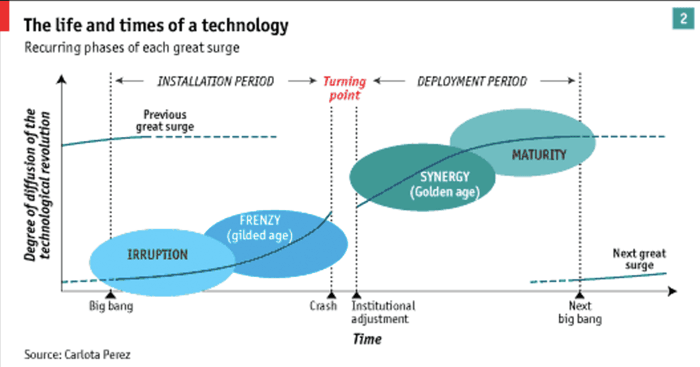
For those of us at USV, this general concept of cycles rings true. The firm’s original investment thesis was deeply influenced by the work of economist Carlota Perez, and her theory of “technical revolutions” as described in the book Technological Revolutions and Financial Capital: The Dynamics of Bubbles and Golden Ages. Perez also describes a 4-part sub-cycle, with each overall “revolution” lasting roughly 80 years:

At USV, we spend a lot of time discussing this cycle, especially as it relates to the nature of the internet/tech market, and which parts are expanding and which parts are consolidating — for example, we’re clearly in the deployment phase with regards to the web platform and app ecosystem, while the blockchain may open the door to another market expansion.

But the larger point here is that it absolutely feels like we are at a pivot point, one way or another — a transition point in the cycle. My colleague Albert has chronicled this extensively on his blog and in his book World After Capital, where he argues that we are at the transition between the industrial era (where capital is scarce) and the information era (where attention is scarce). An important point that Carlota makes is that as each revolution sets in, it brings with it not only new technological underpinnings, but also a whole suite of cultural, legal and institutional changes:

“The new paradigm eventually becomes the new generalized ‘common sense’, which gradually finds itself embedded in social practice, legislation and other components of the institutional framework…”

Both Perez and Strauss/Howe note a period of “turbulence” between cycles — and in the case of Strauss/Howe, this is more than just a momentary blip but rather the entire fourth “turning”, which is crisis. This is the part that’s so obviously scary — of course, as the fundamental underpinning of the economy change, that changes everything, causing real trauma. Right now maybe that’s expressed as immigration policy and nationalism, but really it’s more about the impact of information technology on jobs and the economy.

One thing I still don’t have a clear read on is that Bannon’s apparent effort to “deconstruct the administrative state” feels like an explicit attempt to hasten the development of the cycle, while the broader Trump campaign branding and agenda (“make America great again”) feels like an attempt to slow down this transition, bring things back to how they were.

It feels clear to me that the attempts to put the information era genie back in the bottle will be futile — we have turned the corner to a global, connected world. But in the meantime, economic nationalism is a natural response to that, especially in lieu of a clear policy and political vision that embraces the connected world, but distributes the costs and benefits more equitably.