A few months ago, I had the pleasure of being part of an event called Hacking Society — I helped organize the event w/ the folks at Union Square Ventures, and it was a real honor to spend a day surrounded by many of my internet heroes.
It’s taken us a little while, but we’ve been working through the transcripts and recordings from the event, and have been piecing together some video clips. Today we posted the first set, and a bunch more will be ready soon. Fred has a post up today about one of them: a conversation about the problem of money in politics, kicked off by Larry Lessig, leading to some brainstorming about how we might hack at the problem. As always, the commenters on Fred’s blog are having at it, so I’ll go jump in the conversation there.
I’ve spent a decent portion of the last few weeks listening through the audio from Hacking Society, to the point where I feel like everyone from that day is actually residing inside my head. Which is weird, but also nice. I encourage you to head over there and check out the video, audio, and transcripts and invite those folks into your own brain for a few hours. More videos will be ready soon and I’ll link them up as they come.
It’s no secret that Kickstarter is radically changing the way people think about launching new products. They are on a such tear helping projects get funded by the crowd (the latest being OUYA, an open gaming platform, which has raised $5mm so far, 5x its goal), that it’s no surprise that the model is spreading.
Kickstarter didn’t invent the “tipping point” model of organizing group action (my first recollection of it was from a site called ThePoint, which ultimately became Groupon — here’s an archived shot from 2008), but they’ve definitely taken it mainstream. Now you see the basic model being replicated everywhere (for example, Rally for causes and Thunderclap for massive group tweets), and I’m sure VCs can’t stop the phrase “it’s Kickstarter for ____” from ringing in their ears.
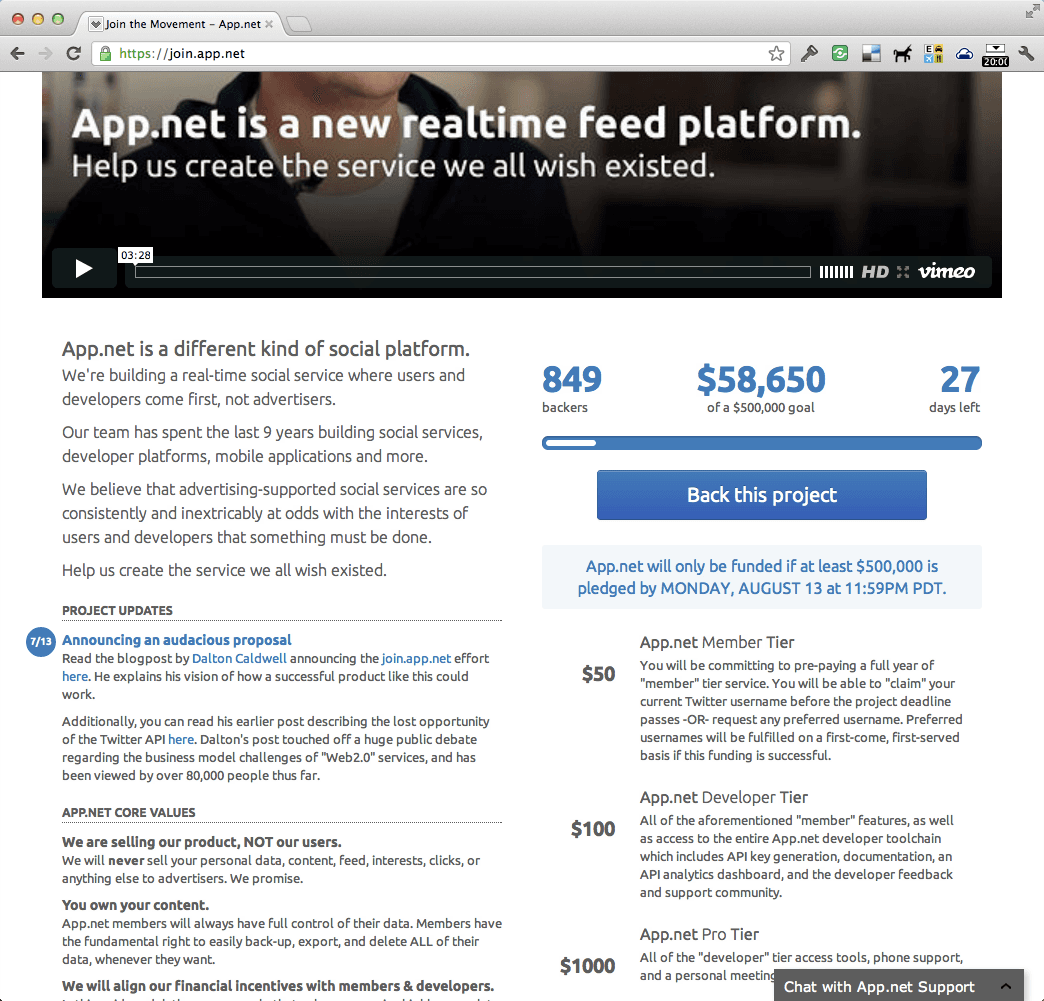
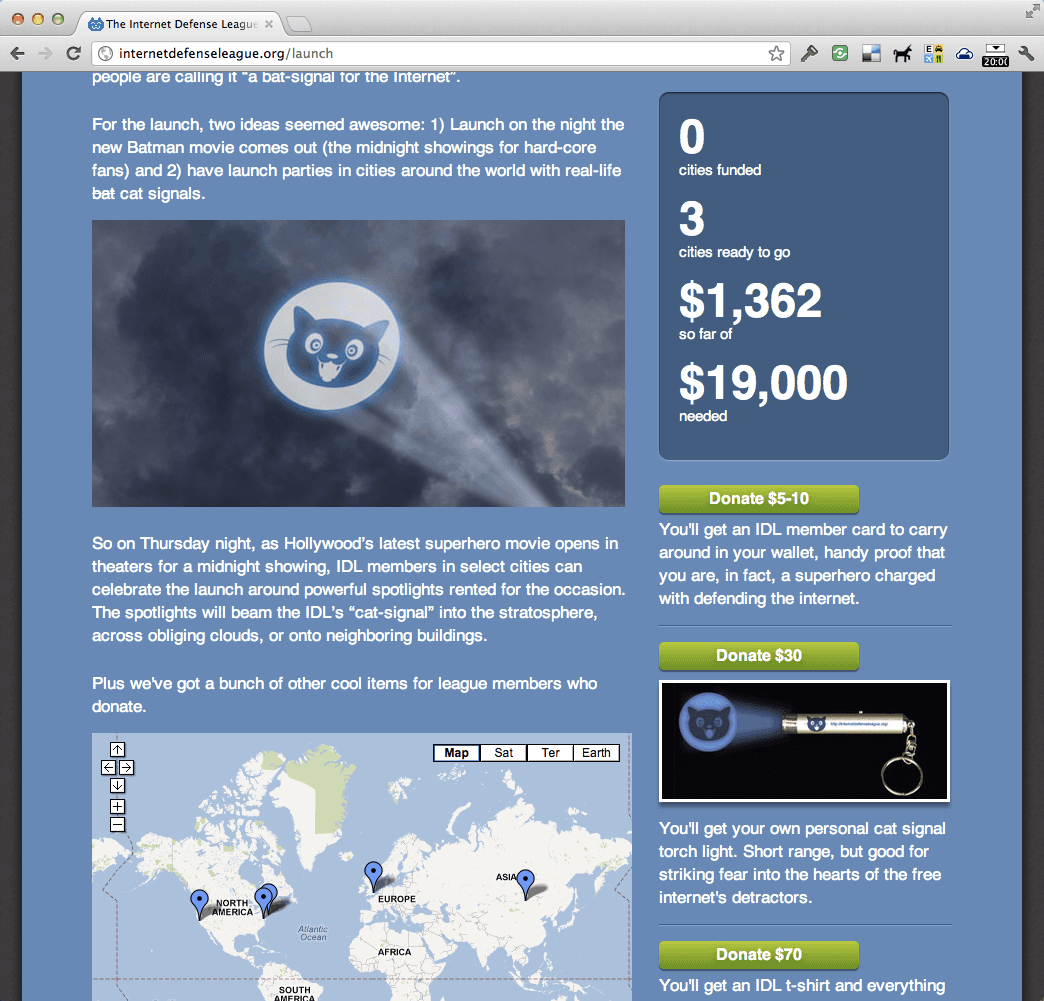
What’s interesting to me is that in addition to these new Kickstarter-like platform, we’re also seeing the Kickstarter model being attempted in the wild — independently by projects looking for launch funding. I’m calling this approach the “Kickstarter Protocol” model.
For instance, here is App.net’s Kickstarter-like page:
Both of these read closely from the Kickstarter playbook, including tiered support levels tied to creative rewards.
It will be interesting to see how this plays out — I suspect that both projects have a good chance of reaching their goals (particularly IDL w/ it’s more modest number), in part because the organizations behind them have big networks already.
If this approach starts to work, I suspect we’ll see more of these, for a few reasons: 1) control of identity — the IDL launch site is in situ, which helps bind it more tightly to the campaign; 2) for cost savings — as expensive & time consuming as it is to build a website like this yourself, if you’re hunting big game, saving the 5% that Kickstarter takes is meaningful; and 3) for routing around restrictions that some funding sites impose on which projects are allowed to use the platform.
I don’t see this kind of thing having a meaningful negative impact on Kicksktarter’s business, but it does raise some interesting questions about the value that the Kickstarter platform and audience network bring to the table. For smaller projects, where project leaders don’t have the skill or resources to go independent, it’s clear. But for larger projects, where success is more about internet-wide buzz building off of existing networks, you could make the argument that Kickstarter the platform & network provides less value.
We spent this weekend in Cape Cod w/ Frannie’s family — her family has been renting the same small cottage by the beach in Truro for 35 years or so, and we spend a lot of time out there in the summer.
This year, our old friend Tati introduced perhaps the greatest beach innovation ever. The Waboba. For those who have yet to experience it, a Waboba is a ball that bounces on water. The ball is made of gel, and is wrapped in wetsuit-like material.It’s amazing — so fun in so many ways. We played in a small tidepool, close together. We played in the ocean, skipping the ball, long distance, up, over and across the waves. It seems silly to write a blog post about a beach ball, but this is really something special.
Just check out a Youtube search for Waboba to see how people are using it (and how many people are filming it). We had the Waboba Extreme, which sets you back $8.99 . If you’re spending time in the water this summer, I highly recommend doing it w/ a Waboba.
I haven’t been following the story of the Digg acquisition too closely, and have no perspective on the economics of it, but it does seem kind of awesome in a way. In that, the acquirers of the various parts of digg seem to have each gotten something uniquely valuable (to them) and likely have the potential to do something cool with it. From the TechCrunch story:
According to a familiar source, the Washington Post ended up paying $12 million for the Digg team. Around the same time, career social network LinkedIn paid between $3.75 million and $4 million for around 15 different Digg patents including the patent on “click a button to vote up a story”. Betaworks picked up all the remaining assets today, including the domain, code, data and all the traffic for between $500k and $725k
betaworks has acquired the core assets of Digg. Digg is one of the great internet brands, and it has meant a great deal to millions of users over the years. It was a pioneer in community-driven news. We are turning Digg back into a startup. Low budget, small team, fast cycles. How? We have spent the last 18 months building News.me as a mobile-first social news experience. The News.me team will take Digg back to its essence: the best place to find, read and share the stories the internet is talking about. Right now. We are going to build Digg for 2012. More to come…
From an outsider’s perspective and without really knowing anything about this deal, it seems kind of perfect. The Washington Post acquires a team who really knows something about being creative with news — if that works right, then they’ll have a shot a solving the Innovator’s Dilemma and building something new and disruptive inside their world. LinkedIn, now a for real Big Boy Company, gets to bolster its patent portfolio like all the big boys do. And Betaworks gets to reinvigorate a classic, once-awesome brand, while at the same time, handing their new product, News.me, a big bootstrap. This last part reminds me of when Delicious’ co-founders bought the company back and gave it new life — which has been awesome for the product so far.
So, who knows if this is a good thing, or was a good deal for any of the parties involved. But it does feel like a win on a number of levels.
For the past few months, it seems like I can’t read the news without coming across another horrifying story of sexual abuse within “esteemed” institutions.
Today marks the release of the “Freeh Report” — the independent analysis of what happened at Penn State with Jerry Sandusky. The Washington Post is live blogging the report’s release here, and the long and short is that it’s a scathing critique of Penn State’s institutional protectionism at the expense of the welfare of children who suffered decades of abuse.
Similarly, over the past year, it’s come to light that a similar story of decades-long abuse by an esteemed football coach, covered up and enabled by the school’s administration, took place at Brooklyn’s Poly Prep.
It turns out that the Boychoir case was led by Larry Lesssig, who was himself a victim of abuse at that same school. I actually hadn’t known that story, and helps my understand Larry’s deep understanding of, and commitment to changing root-level corruption in our institutions.
It is horrifying to read all of these stories. In every case, vulnerable children (because of their age, ambitions, or personal challenges — all of Sandusky’s victims were from the foster care system), are not only abused physically, but are totally head-fucked, as they’re drawn into a complex morass of complicity, confusion, and shame. And to see the constant, relentless pattern of institutions prioritizing their own outward appearances over addressing these criminal and tortuous situations is just so so shameful and sad.