Why Sliderocket Could Be So Awesome, and Why It Isn't

Jul 31, 2012

I wrote the other day about wanting a better way to share slide presentations. I think there is a huge opportunity here, and I don't think anyone has nailed it yet. I consider this to be an open letter to Sliderocket, which is so close to capturing this opportunity but has (in my humble opinion) made a few key mistakes that will prevent it from succeeding. First, the opportunity: every day, all around the world, people give presentations (keynote powerpoint, etc), in meetings, at conferences, and lots of other gatherings. There are a LOT of ideas communicated this way on a daily basis. So many. The sum total of the knowledge included in the world's daily powerpoint output is really really big (regardless of your beliefs on power corrupting and powerpoint corrupting absolutely). This output is typically received in a few ways:

  • by the people in the room, who get it in real time
  • by others, via some sort of sharing, like when:
    • the slides themselves are posted to a site like Slideshare,
    • a video of the talk is posted online (for instance, here are all the great talks from this year's Personal Democracy Forum).

This is a decent start, but it's way limiting. It's probably a safe guess that something like 10% of all presentations given on a daily basis are archived in a useful online format. And the online formats available now aren't actually all that useful. BUT - given where we are now with technology and the social web, there's an opportunity to fill this gap. My ideal tool would look like this: 1) Awesome, in-browser editing. In-browser editing is critical - when you're creating your content in-situ (see Fred's good post on this idea here), you can then share, edit, re-share, embed, etc., straight from there. The editing experience should feel great, just like Keynote does, and should ideally be implemented in HTML5, giving it a native in-browser feel (just like the beautiful Moqups). 2) Super easy audio recording. If I'm making a deck for a talk I'm giving somewhere, I'll gladly spend the extra time to do a run-through of audio recording for the online version (as I did with my talk at last week's awesome summit). 3) A handful (don't need a ton) of addons that are native to the web -- analytics, interactivity, embedding, etc. 4) Social - so you can get feedback, collaborate, connect with others, etc. 5) Interoperable - exports to keynote, powerpoint, pdf, youtube, etc. But what about Slideshare?, you might ask. Slideshare was the pioneer in the get-your-powerpoints-online space, but their approach is not web-native or in-situ. They have lots and lots of content, but it's basically crippled without voiceovers (and to a lesser extent, interactivity). They took a stab at it with slidecasts, but it was pretty half-hearted, and it's just plain cumbersome to do (record your own timed MP3 and upload). What about Prezi? Prezi is nice and can create some really beautiful things. I loved Sascha Meinrath's prezi from PdF. Prezi could be great -- downsides I see are that it's a radical paradigm shift with a steep learning curve (not that big a deal), and it still doesn't support audio as far as I can tell (correct me if I'm wrong). But we're getting warmer. What about Sliderocket? There is a reason why I'm calling out Sliderocket in the title of this post. It's because they are SO CLOSE, yet SO FAR AWAY. The vision for the Sliderocket product is wonderful, hitting most of what I outlined above, but the execution sorely misses the mark. Twice now, I've put real effort into switching from Keynote to Sliderocket -- against my own reservations about some of the issues I'll list out below -- and each time I gave up, before switching back again because it's exactly what I want. But in the end, after saying all of the below privately to their customer support team, I just got too frustrated and gave up. First, the good:

  • Online editor that decently approximates the keynote/powerpoint experience (with a few key downsides which I'll get to in a sec)
  • All kinds of interactivity built in -- surveys, popups, comments, etc.
  • Collaboration: both on the editing side (for teams) and the public side (comments etc)
  • Live embeds with analytics -- see who's watching, how long they're looking at each slide, etc. Awesome and amazing.
  • Easy sound recording.

So, you might say: wait a minute, they've done absolutely everything you've asked for! And you're right, they have. It's so awesome. Yes. Except: at every single turn, and whenever they have an opportunity, they make choose to make your life harder, not easier, and they make you hate the service, not love it. For example:

  • Crappy flash UI -- they've built out tons of features, but all using a really clunky flash UI that feels neither like the browser nor like the desktop. It's worse than the web, AND it's worse than the desktop. It just doesn't feel good to use -- it's just a little to slow, just a little too unresponsive. And things tend to break (like this).If that were the extent of it, I could handle it -- and I'd be a sliderocket convert, despite having to get used to a UI that's not as great as it could be. The real kicker, though, is that sliderocket focuses all their attention on a) locking you in and b) goosing you up to their pro plan. And they do it in the most frustrating and manipulative way. For example:
  • Every features seems like a feature, until you try to use it. Then you get an in-your-face upgrade pitch:

Like accessing analytics: Or even exporting: Really? I can't export to any format without a pro account? The first time I saw this, it was a total dealbreaker. Then, I ultimately came back, because I wanted in-situ, interactive, collaborative, social, in-brower slides. Even the idea that my slides would forever be locked inside the sliderocket platform unless I upgraded didn't permanently dissuade me (the first time) -- the potential for what's here is just so great. And, even if you agree with strategy of pushing all users into the pro account as quickly as possible (I don't), the way to do it is NOT to piss them off at every turn when they're trying to get something done. The way to do it is to make them love your product as it is, and then really really want that shiny thing that would make it SO MUCH BETTER but that you're not crippled without. So, if I were in the drivers seat at Sliderocket, I'd see this huge opportunity and I'd fix it as soon as possible. Because their engagement numbers can't be that good right now -- they can't expect to win over die-hard powerpoint or keynote users with their current lock-in strategy, and they can't expect to win over web geeks with their crappy flash UI (on top of that same lock-in strategy), If I were in charge of Sliderocket, I'd say: We have the opportunity to become the platform for communicating ideas. Like TED or TEDx, but for online slides. That means focusing on getting as many people as possible to love our platform as possible, and to build an amazing community of communicators around it. Specifically, that means:

  • Drop the hard sell for the pro account. Instead make the free account awesome and fun, and then get creative about other native monetization strategies. For example, look at what visual.ly is doing.
  • Re-build the UX without all the flash. See Moqups. Or if you still love flash, be more like myBalsamiq (which uses flash for the editor, but wraps it in a very nice HTML experience)
  • Make portability -- import and export -- a key selling point. You don't need to lock people in -- they will want to use your native features because they are so awesome (embedding, interactivity, audio, etc.). That will always be first choice. But they'll need to be able to dump to PDF, PPT, or Keynote at times too. And a proprietary player isn't enough.

I realize that I'm being preachy here. It's only because I think that there is such a need and an opportunity here, and you're so close.
Jane Jacobs, Inspiration, and the Internet

Jul 25, 2012

Last night at 3am, our daughter Brieza started crying, Frannie and I woke up, and I couldn’t get back to sleep. So I crawled over into my office and started surfing the web. For about two hours, I wandered from thing to thing, and seemed to keep hitting gems, like this classic Paul Graham article on doing what you love, this awesome Quora thread on how Apple keeps secrets, these posts by Joe Kraus on “seeing greatness” and the culture of distraction we’re creating (most of these stemmed from McKenna Moreau’s twitter stream). And of course I logged my requisite Wikipedia time, reading up on Freidrich Hayek as well as the history of Fascism. A grand tour, indeed.

One post that really got me thinking was a Quora thread started by Christina Cacioppo asking “Why does Jane Jacobs garner so much respect?

It got me thinking about why Jane Jacobs is inspiring to me. I read Jane Jacobs for the first time during my sophomore year of college at Stanford. At the time, I was feeling rather displaced and isolated, having moved to the northern California suburbs (as beautiful as it is there, in many ways) from NYC. I couldn’t figure out how to engage with the physical and social landscape of the spread out strip mall suburbs of the Valley — I couldn’t see or feel the energy, I couldn’t connect with people (physically, emotionally) the way I had grown accustomed to in New York. The whole thing felt really weird and I didn’t like it.

Then, on a total whim (tagging along with my friend Carrie McAndrews), I took a class called “Introduction to Urban Design” (taught by the epic Gerry Gast), and Jacobs’ The Death and Life of Great American Cities was our first reading. I read the first few chapters, and that was it. I finally had a framework for understanding my feelings for the places I lived in, and without knowing it, I set off on a course of interest that would shape everything I’ve done since.

Without getting into all the detail, the big takeaway was this: there is great power in the infrastructure we build, and the way we build it — and quite often, when we “go big”, making sweeping, top-down plans, we miss the mark, we forget the humanity. Jacobs reminded us that cities are made of people, and people have peculiar ways of working, which are often counter-intuitive. If we want to make great cities, we need to start with a people-eye view of the world, and work up from there. Not a bird’s eye view. Bottom-up, open, and organic, focusing on identifying and strengthening connections.

Jacobs was not a city planner. She was a writer and an activist. This first book, published in 1961, was enormously powerful — it sent shock waves through the city planning community and influenced generations (and counting) of planners. Beyond the book, she was famous for standing up to the forces of Big Planning (Robert Moses), and organizing opposition to projects like the Lower Manhattan Expressway, which would have put an interstate through Manhattan’s Greenwich Village (an idea that seems patently ridiculous now, but was close to being real in the 60’s). She embodied an outsider’s voice of reason, and she marshaled tremendous popular support.

Fast-forward 15 years (if you’re counting from my college days, 50 from the publication), and here we are with the Internet. We have a complex, vibrant medium that’s connecting people in incredible (and sometimes scary) new ways. It was built with an open architecture, upon principles of decentralization, trust, and permissionless innovation. It’s chaotic and messy, and totally awesome. Just like cities. And we have big, powerful forces working hard to lock it down and control it.

I believe in the diverse, open awesomeness of cities, and in the diverse, open awesomeness of the web. Jane Jacobs isn’t my only inspiration (there’s also Steven Johnson, Joi Ito, Fred Wilson, Barbara Van Schewick, Larry Lessig, Jonathan Zittrain, Yochai Benkler, and many many many others), but she’s a big part of the foundation.

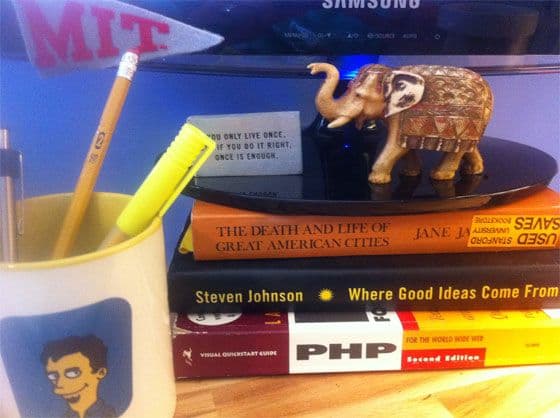
Speaking of foundation, I’m kind of a sentimental guy, and keep a lot of meaning in my stuff. Here’s a picture of my desk, specifically the stack of books holding up my monitor:

Those three books are there for a reason:

  • PHP for the World Wide Web, by Larry Ullman. This is the book that taught me programming. I had taken some in college, but not really focused on it. But this book helped me catch the bug — I did all the exercises, then moved on to more and more. It kicked me into a (now 8-year old) cycle of self-directed learning about technology, programming, and the web. The best education in my life, by far. So thanks, Larry.
  • Where Good Ideas Come From, by Steven Johnson. Steven is my favorite writer of all time. He has an unmatched ability, IMO, to tie together phenomena from the worlds of biology, sociology and technology into an amazingly rich, compelling and long-lasting narrative. The title of this blog, “the slow hunch”, is drawn from this book (check out the video), and I always feel like he’s inside my head with me as I go about my work.
  • and of course, The Death and Life of Great American Cities, by Jane Jacobs. This is the actual copy I bought back in 1998, and I’m enormously proud to say that it’s signed by Jane herself (I met her briefly in 2004, shortly before she passed away).

It’s corny, but I like the idea that these people, stories, and values are propping up my work every day. Standing on the shoulders of giants, so they say.

So, when I think about the Internet, and the fight for the future of everything, I often think “What would Jane do?” (or maybe, WWJJD). And I think the answer is that she would dig into the nuances of How Things Really Work, make a crystal clear, compelling case for what’s great, and organize her fellow citizens to fight against the powerful forces that would change things for the worse. Sounds about right to me.

Advocacy in the Age of Peak Guilt

Jul 24, 2012

Yesterday, I spent the day at the Awesome Summit — the first wholesale gathering of folks involved with the Awesome Foundation. In case you don’t know, the Awesome Foundation is a “micro foundation”, where each month, a group of 10 “micro trustees” donates $1000 (total; $100 per trustee) towards a project that is awesome. No strings attached. It’s a really neat idea, and it has caught fire over the last few years.

And it’s an open source brand — anyone can start an Awesome Foundation in their city (no need to ask permission from Awesome HQ). So far, there are 45 city-based chapters worldwide. For example, here are the projects that have been funded in Kitchener-Waterloo, Ontario, and the ones that have been funded in Melbourne, Australia.

At yesterday’s summit, I was on a great panel, entitled “The End of Peak Guilt”. We talked about alternatives to guilt-driven advocacy — new ways that folks can engage in ways that are creative, fun and social. The panel moderated by Alexis Ohanian, and featured some great folks: Zach Walker from Donors Choose, Andrew Slack from the Harry Potter Alliance, and Michael Norton from the Harvard Business School.

For my part, I talked a little bit about what we’re doing with Connected.io, and did a quick roundup of examples that I feel exemplify guilt-free advocacy.

There wasn’t a video of the talk, so I did a little experiment and created a voiceover video of my slide deck. I recorded this today, and I’m sure I didn’t deliver this with the same gusto as the live talk, but I figure it’s better than simply posting to slideshare.

Side note: in the process of doing this, I realized that there really isn’t a good enough way to share presentations on the internet. People spent countless hours preparing decks and presenting talks — and some of those are recorded and shared, but the vast majority get lost in the wind. Slideshare has a ton of presentations, but they just feel crippled to me without the voiceover. I feel like they have so far missed a huge opportunity to create a deep and interesting content channel. SlideRocket has the generally right idea (in-situ editing, easy audio recording, interactivity, etc.) but they take a super proprietary approach to their service which really turns me off (I should write about that in more detail).

Anyway, that mini-rant out of the way, here’s the voiceover video (which also doubles as the media component to my SXSW panel proposal):

When Paper is Better

Jul 21, 2012

Last week, I spent some time shopping for a new health insurance plan for our family. Two takeaways:

1) The new Massachusetts Health Connector is really great — the health connector is a state-run exchange that helps you find, choose, and purchase a health plan, either a state-run plan or a private plan. My experience using the site was great — the process was very clear and user-friendly, and the customer service on the phone was really good. This exchange is a model for the country, and it felt and worked way way way better than most government websites.

2) There are some times when paper is just better. I haven’t purchased a new health plan in something like 6 years, so it took me a while to wrap my head around all of the possibilities. The Health connector has a nice online comparison tool which gave me a good start. But in the end I was comparing a large number of plans, and needed a higher-bandwidth way to cross check and understand the tradeoffs. So I ended up going the old fashioned route and printing out the listing of all a whole bunch of plans. Doing it this way made all the difference, and within a few minutes I had narrowed my search down to two or three. FWIW, in the end we settled on a high-deductible PPO plan with a health savings account.

So, I love computers but here’s to paper too!

The Internet Defense League

Jul 19, 2012

Today marks the launch of the Internet Defense League, an effort led by Fight for the Future to build permanent infrastructure for defending the internet.

The idea is simple: build a loose, permanent coalition of individuas, companies and websites that stand at the ready to react to threats to the internet. How exactly this works is up to you — there are a number of ways to participate in the league, including (as I’ve done) inserting some JS into your site that will light up at certain times when the net is under threat. I’ve also got a snazzy new badge in my sidebar that fills me with pride every time I look at it.

The past six months has been all about: “how does the internet advocacy movement evolve post-SOPA?”. I see the creation of the defense league as a big, exciting and awesome part of that.

I remember back in the fall, during the building of anti-SOPA/PIPA campaign, FFTF made one of the most creative and effective advocacy moves I’ve ever seen: they offered ways for any website owner to “black out” their logo in protest of the bills. Tons of websites took this up, which helped the meme of the campaign spread laterally, quickly. I distinctly remember setting up my “stop censorship” logo and then feeling an immediate sense of kinship with others on the web who did the same. This is like a bigger and better version of that.

I can say clearly and with pride that I’m part of the global force that will work to defend the internet, in whatever ways I can. That feels good to say.

Tonight, as part of the launch, “cat signals” will light up the sky around the world. I’ll be co-hosting the NYC party on the roof at OpenPlans, along w/ Alexis Ohanian of Reddit. There are still free tickets available, so RSVP here if you want to come. I can’t wait to help flip the switch.