Zero-rating: putting Net Neutrality to the test

Jan 5, 2016

It’s been an intense 10 months since the FCC approved its latest Open Internet rules (aka Net Neutrality).

On the wired side, we’ve seen the unbundling of content, as channels such as HBO (via HBO Now) and ESPN (via Sling TV) have split from cable to go “over-the-top” with direct-to consumer offerings. These are a direct result of the clear FCC rules prohibiting broadband providers from throttling, degrading, or otherwise fucking with this internet traffic. This is clearly pro-consumer, as people can now buy the channels they want unbundled from the crap they don’t, and it’s pro-innovation, in that even the smallest video startup is now competing on even footing with the big guys — I can launch a video service tomorrow that competes head-on with HBO or ESPN, and both of us have exactly the same distribution, without having to cut a deal with the cable company.

On the wireless side, it’s been much more of a circus, as wireless providers experiment with a variety of so-called “zero-rating” plans. Zero-rating is the practice of selectively exempting certain content from wireless data caps. Zero-rating isn’t monolithic — there are many ways one can do it, which are varying degrees of bad — which is why the FCC didn’t explicitly rule on zero-rating, but rather left it up for review on a case-by-case basis.

The two cases that are happening right now are T-Mobile’s Binge-On, which exempts certain video providers from data caps (and throttles the speed of all video), and Facebook’s Free Basics (formerly Internet.org), which offers free access to Facebook and partner content to mobile users in India and Africa.

Both have been controversial, and Free Basics wildly so.

The question that we’ve been wrestling with is: if you believe that exemptions from data caps are pro-consumer (and this is not a given), then to what extent to these programs enable or limit open competition? To what extent are they “open” or “neutral”? To what extent are the underlying platforms controlling access, playing favorites, and limiting competition?

Looking at it that way, then Free Basics is really, really, really bad, and Binge-on is just kind of bad.

With Binge On, any “qualifying provider” can join the program and have their video content exempted from participating users’ data caps (here are the exact terms). So, you still need to jump through a hoop to get outside of the cap, but theoretically anyone can do it; you don’t need to cut a special deal with T-Mobile. Then, T-Mobile also throttles download speeds of all video for participating customers (regardless of whether the source is a Binge-on partner). While this is sucky and disingenuous, and clearly violates the FCC open internet rules, it doesn’t have as huge a direct impact on competition & innovation as Free Basics does.

The question Binge-on raises is: are data caps necessary at all, and what impact does throttling video have on video innovation and investment in network capacity. Those are valid points which are central to the theory of the virtuous cycle of investment in content and infrastructure and the reason for the FCC’s ban on throttling by content provider or by class of content (in this case, video).

Free Basics, on the other hand, is creating a Facebook-controlled walled-garden — a modern-day “AOL on the Internet” — where partners must both be approved on a one-by-one basis, and must also submit to having their content completely proxied and remixed through Facebook’s platform. This post — Free Basics is a Nightmare on the Internet — has a very detailed breakdown of the issues with Free Basics.

For the hundreds of millions of users who join the “internet” via Free Basics, they won’t be joining the real internet, they’ll be joining “Facebooknet” — a limited, controlled version of the internet that lives inside of Facebook. This is clearly not a charitable program offering access to millions of unconnected users, but rather a brilliantly evil user acquisition and business development strategy.

So, the question then becomes, what would be a better way to deliver internet access to the hundreds of millions of people who will be coming online in the next decade? How can we ensure that they get connected, and also ensure that they benefit from the diversity, openness and innovation of the real internet? How can we design access programs that are pro-consumer, pro-competition and pro-innovation?

I won’t go into all the details here, but there are a few ideas, including:

Related are the points that internet access in India is already growing very quickly without Free Basics (India grew from 300M to 400M mobile users in 2014) and that smartphone purchase is actually the most expensive part of getting online, not data access.

So, I suppose that the “network level” innovation that’s happening here is good in that it’s teasing out all the possible schemes and giving us a real close look at the details of each. My view is that, despite its warts, T-Mobile’s Binge-On is closer to the spirit of bringing users the whole internet as quickly and cheaply as possible, while Free Basics is closer to a geniusly evil world domination scheme.

Hello, 2016

Jan 4, 2016

Breaking the ice — been off the blogs for quite a while now.

Looking forward to this year, the way I tend to every year. 2015 was a tough one for me personally — went through a bunch of shit on the family front that both demonstrated how tough life can be and also how resilient people are.

I’m incredibly thankful for my friends, family and colleagues, who continue to inspire, support and challenge my family and me.

Let’s get it on.

As Massachusetts ponders ride-sharing regs, where’s the data?

Sep 15, 2015

Today, hearings begin at the Massachusetts state house over how to regulate the budding ride-sharing / on-demand transportation industry (Uber, Lyft, et al).

Adam Vaccaro over at Boston.com has a good summary of the various competing bills — a pro-Uber bill that welcomes new Transportation Network Companies (TNCs) with relatively light-touch regulation, and a pro-taxi industry bill that makes it harder for TNCs to operate.

As I’ve written about before, I think the emergence of ride sharing, on-demand, TNCs is a good thing. It makes getting around the city easier and safer, and it provides a flexible opportunity for work. And, as cities ponder how to regulate them, they need to think differently — looking at the data-driven trust and safety techniques the TNCs bring to bear as a “regulatory innovation” rather than a threat to traditional law & order.

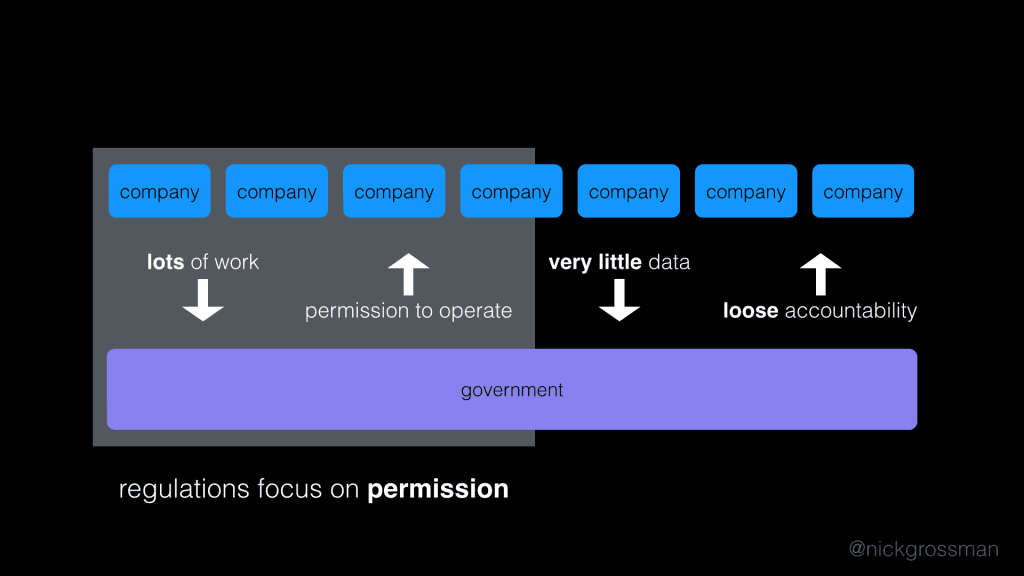
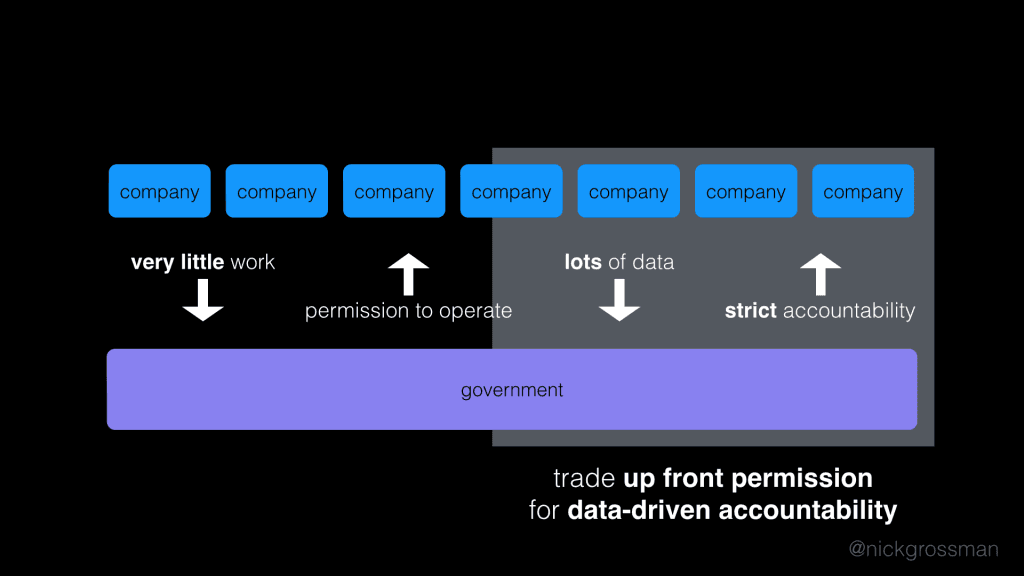
I call it “regulation 2.0” – thinking about public sector regulation the same way platforms (uber, etsy, airbnb, ebay, etc) think about “trust and safety”, by loosening up-front requirements for participation in exchange for data-driven accountability:

moving from this:

Platform-Gov-regulations.004

to this:

Platform-Gov-regulations.005

So, looking at Massachusetts, what’s the one thing missing from any of the proposals? Data.

The proposals cover important issues like insurance and passenger safety, and largely differ on how easy it is for platforms and drivers to get started. But none of them make any mention of the data being generated by these platforms, why it matters, and what it can be used for.

I recently spoke with someone in the NYC Mayor’s office about their ongoing efforts to understand the impact of TNCs on the city, and to regulate appropriately. As a refresher, NYC recently dropped their bid to regulate the supply of Uber drivers and instead opted to study the impacts of TNCs on city traffic.

It became clear to me that the city is basing its regulatory decisions on very little data. The Department of Transportation doesn’t have reliable, standardized, longitudinal data, the Taxi & Limousine Commission (the taxi industry’s regulator) doesn’t keep usable data, the city doesn’t have partnerships with other transportation data networks (for example, Google/Waze, Verizon, AT&T, etc).

My argument, then, is that a primary point of negotiation between cities and TNCs (and any other web/mobile powered network that intersects with regulated aspects of the city — food, housing, etc) should be about access to data. For web/mobile platforms, data is a huge asset, yet for cities it’s not even on the table.

Of course, this has to be a trade. No platform would be willing to share performance data without a proper incentive. And my point is that the incentive should be fewer traditional regulations, and more freedom to operate, in exchange for data sharing.

Further, data negotiated by cities in these situations should be available publicly, to enable independent analysis by third parties. Not only do cities not have the internal capacity to analyze such data, but they also want any conclusions they draw to be verifiable and peer-reviewable. Just like science. So that, if and when they do decide to enforce regulations, they have a leg to stand on

One saving grace is that this conversation is happening over and over again in cities across the world, so we’ll see many permutations of solutions and outcomes, and hopefully some cities will start to get it right and get the best of both worlds: more competition, more experimentation. Less regulation, more data. Better transportation and safer, more convenient cities.

As Massachusetts ponders ride-sharing regs, where's the data?

Sep 15, 2015

Today, hearings begin at the Massachusetts state house over how to regulate the budding ride-sharing / on-demand transportation industry (Uber, Lyft, et al). Adam Vaccaro over at Boston.com has a good summary of the various competing bills -- a pro-Uber bill that welcomes new Transportation Network Companies (TNCs) with relatively light-touch regulation, and a pro-taxi industry bill that makes it harder for TNCs to operate. As I've written about before, I think the emergence of ride sharing, on-demand, TNCs is a good thing. It makes getting around the city easier and safer, and it provides a flexible opportunity for work. And, as cities ponder how to regulate them, they need to think differently -- looking at the data-driven trust and safety techniques the TNCs bring to bear as a "regulatory innovation" rather than a threat to traditional law & order. I call it "regulation 2.0" - thinking about public sector regulation the same way platforms (uber, etsy, airbnb, ebay, etc) think about "trust and safety", by loosening up-front requirements for participation in exchange for data-driven accountability: moving from this:

to this:

Platform-Gov-regulations.005

So, looking at Massachusetts, what's the one thing missing from any of the proposals? Data. The proposals cover important issues like insurance and passenger safety, and largely differ on how easy it is for platforms and drivers to get started. But none of them make any mention of the data being generated by these platforms, why it matters, and what it can be used for. I recently spoke with someone in the NYC Mayor's office about their ongoing efforts to understand the impact of TNCs on the city, and to regulate appropriately. As a refresher, NYC recently dropped their bid to regulate the supply of Uber drivers and instead opted to study the impacts of TNCs on city traffic. It became clear to me that the city is basing its regulatory decisions on very little data. The Department of Transportation doesn't have reliable, standardized, longitudinal data, the Taxi & Limousine Commission (the taxi industry's regulator) doesn't keep usable data, the city doesn't have partnerships with other transportation data networks (for example, Google/Waze, Verizon, AT&T, etc). My argument, then, is that a primary point of negotiation between cities and TNCs (and any other web/mobile powered network that intersects with regulated aspects of the city -- food, housing, etc) should be about access to data. For web/mobile platforms, data is a huge asset, yet for cities it's not even on the table. Of course, this has to be a trade. No platform would be willing to share performance data without a proper incentive. And my point is that the incentive should be fewer traditional regulations, and more freedom to operate, in exchange for data sharing. Further, data negotiated by cities in these situations should be available publicly, to enable independent analysis by third parties. Not only do cities not have the internal capacity to analyze such data, but they also want any conclusions they draw to be verifiable and peer-reviewable. Just like science. So that, if and when they do decide to enforce regulations, they have a leg to stand on One saving grace is that this conversation is happening over and over again in cities across the world, so we'll see many permutations of solutions and outcomes, and hopefully some cities will start to get it right and get the best of both worlds: more competition, more experimentation. Less regulation, more data. Better transportation and safer, more convenient cities.