Hacking todos: daily review for Wunderlist

Dec 3, 2012

I have had a hard time finding the perfect to-do list system.

I am a light implementer of GTD — I haven’t read the whole book, but I get the basic idea — capture; focus; do. Stop working from the top of your inbox. Amen.

A few years ago, I started using Things for Mac, which is quite nice. But I got frustrated at how long it took for Things to roll out over-the-air sync between desktop and mobile (it took them 2 years), and so I switched to Wunderlist. But Wunderlist didn’t quite feel as nice as Things, and I always wanted to switch back. Finally, in 2012, Cultured Code released Things 2 which solved the sync problem. Woohoo!

Sync worked great, and they even added a really thoughtful new feature called the Daily Review. Daily Review helps you manage your list of “today” tasks by automatically bumping them off of the “Today” list at the end of each day, and then asking you whether you wanted them to go back to the “Today” list, or go into the “Next” list (where tasks are parked for later review). Basically, forcing you to proactively re-build your Today list at the beginning of each day. It turns out that this very subtle feature was the difference between me engaging with my todo list on a daily basis, and getting overwhelmed by a todo list that just kept getting longer and longer every day, which ultimately just made me lose faith in the todo list system.

Anyway, on Things 2 Everything was hunky dory and I was *super* productive

Then, I switched to Android. Which has been great. However, Things is mac / iOS only. No support for Android (by comparison, Wunderlist is completely cross-platform / html5).

So, once again, I was on the market for the perfect lightweight todo list system. Here’s the set of requirements that I was looking for:

  • Nice desktop experience on Mac (either through a native app or a single-site browser via Fluid)
  • Seamless syncing between desktop and mobile (for me, mac + android)
  • Really quick drag & drop reordering / prioritizing (desktop & mobile)
  • Create a task by email (in my case, by fwding an email thread for follow up)
  • An easy way to do “Daily Review” as created by Things

Turns out it is hard to find this combination of features, packaged in a UI that feels nice (simple & quick for the most frequent tasks).

I tried everything. Any.do, Do.com, Asana, Producteev, Wunderlist. I’m sure there were more. Nothing did everything on the list above just right.

What I really wanted — but just couldn’t have — was Things 2, but with an Android client.

So, I figured maybe there was a way to hack one of the existing Android options to get what I wanted.

My first stop was Do.com — Do is pretty good, and even has an API that lets you hack on it. The mobile client is decent (has drag & drop to reorder, which Wunderlist doesn’t, sadly). The web / desktop UI is more complex than the others, to a fault (IMHO). But I applied for an API key and never heard back, so so much for that.

In the end, I hacked Wunderlist to be more like Things — specifically to make work for the Daily Review / Today / Next workflow. Here’s how it works:

  • Use “Lists” to create buckets for Today/Next/Later/etc, including one for Daily Review.
  • Create a shell script that will take all of my “Today” tasks and move them to the “Daily Review” folder. I am thankful that, despite there not being a public API for Wunderlist, there is at least some documentation, and the underlying database schema is really straightforward (this script makes edits directly to the Wunderlist Sqlite database).
  • Every morning when you’re starting your day, run $ today to initiate the script. Then, work through your daily review list, moving today’s tasks to the Today list and everything else elsewhere.

This is clearly janky, and won’t work for everyone (especially if you use “projects” within Things), but for me it’s doing the trick so far. Here is the code on Github, with detailed instructions.

Hooray for hacking!
Networks Under Threat

Nov 28, 2012

There is a practically non-stop flow of threats to the Internet. That’s because the Internet is fundamentally empowering and therefore also threatening to those whose power is diminished.

This week, there are two big things on the forefront, which my colleague Albert has written up today. Both issues — how the US protects (or sacrifices) individuals’ privacy on the web, and how the internet is fundamentally governed — are super important.

In particular I am concerned about privacy — I suspect that most people really have no idea quite the extent to which companies and governments are tracking their every move. And I suspect that this issue is going to go mainstream in 2013. It’s an issue that both governments and the private sector need to really get right — on the private side, in order to earn the trust of customers, and on the public side in order to ensure a free society.

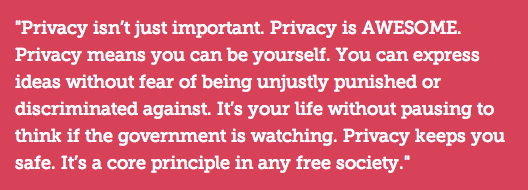
Vanishingrights.com does a great job describing what’s at stake with privacy reform (in this case, the Electronic Communications Protection Act). This quote particularly stood out to me:

So, I encourage anyone reading this to think about both of these issues and why they’re so important, and take a moment to call your representatives.

Separately, with the help of the inimitable Mike Masnick I have started a hackpad to keep track of “networks under threat” – a timeline history of public conflicts between new networks and the incumbent hierarchies they threaten (think: Coursera being banned in Minnesota, AirBnB being banned in NYC, etc.). Feel free to hack on that with us!

Copyright Reform, Peer Progressives, and the New GOP

Nov 20, 2012

It’s been a fascinating few days in the politics of information.

Late in the day last Friday, the House Republican Study Committee released a report that took a fresh look (for American major political parties) at copyright reform, which has since set off a firestorm.

The report addresses three common misconceptions about copyright:

  1. The purpose of copyright is to compensate the creator of the content
    (No, the purpose is to incentivize the production of creative works)
  2. Copyright is free market capitalism at work
    (Actually, it’s a form of government subsidized monopoly)
  3. The current copyright legal regime leads to the greatest innovation and productivity
    (Actually, the current regime stifles many aspects of modern innovation and productivity, and leads to rent-seeking and economic drag)

Then lists a handful of practical problems with today’s copyright regime:

  • Retarding the creation of a robust DJ/Remix industry;
  • Hampering scientific inquiry;
  • Stifling the creation of a public library;
  • Discouraging added-value industries;
  • Penalizing legitimate journalism and oversight.

And finally goes on to suggest four major reforms that would improve the situation:

  1. Reform Statutory damages
    Under current law, damages are generally applied by statute (not by actual damages), leading to typical requests for $150,000 per infringement of a copyrighted work. This is out of touch with the reality of actual damages, clogs up the court system, and as Khanna suggests: “the idea that your iPod could make you liable for a billion dollars in damages is excessive”.
  2. Expand fair use
    While the US has fairly generous fair use provisions relative to elsewhere in the world, it’s still not kept pace with todays technology (copying as part of everyday management of digital files) or culture (remix).
  3. Punish false copyright claims
    Under today’s laws, infringing a rights holder’s copyright (i.e., by copying or sharing a file without permission) is severely punished, while incorrectly violating someone’s lawful use of content (like when the DNC livestream was taken down — incorrectly — for using copyrighted music) is completely unpunishable. This is ridiculous and unfair.
  4. Limit copyright term
    Khanna suggests a reduction in the term of copyright, which — for those who don’t follow this space — has grown from the constitutional provision of 14 years (renewable for another 14 years if the author was alive) to the current system of lifetime of the author plus 70 years. The latest extension, in 1998, has been dubbed the Mickey Mouse Protection Act, as it was timed with the impending expiration of Disney’s copyright of the original Steamboat Willie film.

For folks who have followed the copyright debate, none of these ideas are new. What is new is hearing them from the official research arm of a major political party in the US.

Not surprisingly, the report received immediate praise from many in the tech community, who have grown increasingly frustrated with the state of copyright law in the US and its incompatibility with digital culture and modern innovation.

Perhaps more interestingly, the report was also hailed by members of the Republican party, who see this as one of the key issues for the future of the party — one that can help them re-connect with a younger generation that has the web in their blood (and therefore has a very different conception of content ownership and the right to remix). Here is a tweet from influential republican strategist Patrick Ruffini:

GOP leaders who embrace Internet culture + copyright reform may be one of the easiest things we can do to win over young voters.
— Patrick Ruffini (@PatrickRuffini) November 18, 2012

And then, in a move that was not at all surprising, the RSC retracted the report, less than 24 hours later and reportedly under pressure from copyright industry lobbyists.

All of this raises a question we have been asking for some time now: who will be the party of the Internet Generation?

Our view (and I’ll get to who “we” is in a second) is that the internet — and network-based solutions powered by it — have caused a substantial mind shift in young people. The Internet Generation simultaneously understand the importance of community-driven solutions and non-economic forms of production, and also have an aversion to top-down, bureaucratic regulation. Neither the ideology of the left nor the right fits. The “we” I’m referring to is the group that Steven Johnson dubs the “Peer Progressives” — a group that believes in networks, markets, open platforms and collective action. My colleague Albert Wenger has written a fair bit about the idea.

So, another way to ask the question above is: who in America will adopt the Peer Progressive agenda? Our view is that whoever does, will — by using the lens of network-based solutions — be both most effective at solving our biggest problems AND most effective at attracting the Internet Generation to its ranks.

In today’s Times, David Brooks has an opinion piece on The Conservative Future, in which he teases out some of the tensions facing conservative politics, outlines several sub movements, and specifically mentions the RSC report and it’s author, Derek Khanna:

Rising star Derek Khanna wrote a heralded paper on intellectual property rights for the House Republican Study Committee that was withdrawn by higher-ups in the party, presumably because it differed from the usual lobbyist-driven position.
….
Since Nov. 6, the G.O.P. has experienced an epidemic of open-mindedness. The party may evolve quickly. If so, it’ll be powerfully influenced by people with names like Reihan, Ramesh, Yuval and Derek Khanna.

It will be interesting to see if the GOP does try to become the party of Peer Progressives and the Internet Generation. This question is completely up for grabs right now — I’d say the Dems have a leg up on social issues, but they’ve got a long way to go on understanding the Internet; and both the Republicans and Libertarians have some natural alignments but some big disconnects. This will be a really interesting story to watch play out, and see who ultimately finds the new center (which isn’t really at the center, but perhaps on a slightly different dimension).

Bureaucracy and Trust

Nov 9, 2012

Yesterday, I spent the day at a meeting on “city innovation” at Harvard’s Kennedy School, with 30 or so CIOs, CTOs, and other technology executives from around the country. I did a short presentation on predictive analytics and cities (slides here) — thanks so much to everyone who sent in comments and who emailed me with suggestions.

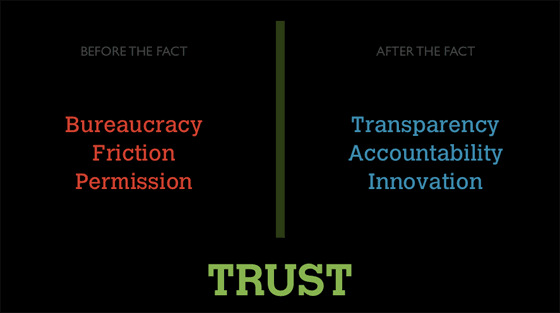
The “aha!” moment of the day came during a coffee break conversation with Boston CIO Bill Oates. Bill was describing how frustrated he felt by the city’s procurement process (this is widely known as a problem across government). He said that he felt like he was “handcuffed” by having to prove — up front, and before actually doing anything — that he wasn’t being dishonest, wasn’t corrupt, and was serving the city’s best interests. What if, he asked, he could instead proceed ahead and prove — after the fact — that his actions were pure. Using transparency, rather than bureaucracy, to establish accountability and ultimately trust.

This strikes me as a big idea.

What we have now — in the era of increasing information liquidity — is an opportunity to re-think the way we establish trust. This idea has been proven out by web services (think Ebay, Airbnb, StackExchange), and I think it’s time we start thinking about how this applies to public sector policy and regulation.

After the conversation with Bill, I ran back to my seat and sketched out the idea, then quickly turned it into a slide for my presentation in the following session. This is what I came up with:

`

The idea that the purpose of bureaucracy and (certain forms of ) regulation is to establish trust is perhaps obvious. But something about it struck me as a new way of looking at things.

It’s an idea that superblogger David Alpert gets at in his coverage of the Uber / DC fight, which he describes as a conflict between the “permission model” and the “innovation model”.

I understand that it’s hard to get past the permission-based way of thinking. Before information was available in real-time, it was the best way to make sure bad things didn’t happen. But we have a new tool — real-time information — that makes a new approach possible. Yesterday at Harvard, we were discussing this in the context of government procurement. At USV, we’ve been talking about it a lot in the context of online privacy (I’m pushing Brad to write about his idea for this soon).

Hopefully you’ll find this helpful — I think I’ll be coming back to it w/ some frequency now as we continue to work on this stuff.

Predictive Analytics and Cities

Nov 7, 2012

It’s been a big year for predictive analytics.

I’ve been following Nate Silver’s blog on the election, and his deep data analysis cut through the noise, was consistent, and ultimately proved correct.

And to look at another (eerily prescient) example, look at this 2006 prediction of what a major coastal storm could do to the East Coast.

We have lots and lots of data about what has happened, and we’re just starting to figure out how to use it.

Tomorrow, I’m attending a conference on Innovation and Cities at Harvard’s Kennedy School, and I’ll be speaking on a panel on predictive analytics and cities. I’ll be joined by New York City’s Director of Analytics, Michael Flowers and Chicago’s (first ever) Chief Data Officer, Brett Goldstein. Both Brett and Michael are way deeper on this subject than I am, so my hope is to simply ask some provocative questions, and perhaps give some examples from outside the civic sector.

A few weeks ago at the Ford Foundation’s Wired for Change conference, MIT’s Cesar Hidalgo gave a thought provoking talk on the power of big data and predictive analytics. A big takeaway from his talk was that by looking at how data is connected — i.e., focusing on a few of data as a network, rather than as sums of numbers — we can quickly and compellingly start to see new trends, tell new stories, and predict future outcomes.

Cesar presented some research that looked at national exports in terms of connections between products and industries. By creating such a “map” of the ecosystem, using historical data, it actually becomes relatively easy to guess which sectors will continue to grow and how. For example, here is a look at South Korea’s export economy over time:

This simple, but profound, change in approach holds tons of potential for us to understand what’s going on in our cities and countries, and better prepare (for economic changes, natural disasters, etc.). You can play with more visualizations of world economic data at MIT’s Observatory of Economic Complexity.

So, looking ahead to tomorrow’s conversation: the specific topic of conversation is:

Predictive analytics cut across issues and datasets. When it comes to potential new forms of analytics, what are the low-hanging fruit? What are ambitious, longer-term ideas of new ways to use predictive analytics to tackle urban issues? What could/should cities do together?

I have some ideas — for instance, generally taking an open data and open standards approach at the foundational level (to widen the audience of potential data miners). Looking for data sets that tell us a lot about how the city works, but might not be the first ones we think of (such as taxi drop off locations, long-distance call originations, tweets, supermarket and other consumer spending data, etc.). I’ll keep noodling on it today and tonight.

What do you think?