The Adaptive Metropolis

Sep 26, 2013

I’m writing this from a plane en route to Berkeley for what should be an awesome conference: Adaptive Metropolis: User Generated Urbanism. Among the organizers is my favorite DIY city-making collective: ReBar.

Back in 2005, ReBar did something amazing. They pulled up to a San Francisco parking space and put in a few quarters. But instead of parking a car there, they rolled out sod, set up a park bench, and created a tiny, temporary public park. They called it Park(ing). Check it out:

The point, of course, is that charging cars $1 or $2 / hr to be there is a pretty lousy use of public space. And that becomes really obvious when we experiment with using that space for other, more awesome things.

That stunt, and the video about it, ended up sparking something of a mini movement. Later that year, there was an entire day in SF devoted to Park(ing). After that, more cities joined in. Back at OpenPlans, we helped organize NYC’s Park(ing) days in 2008 and 2009. In 2011 (the last year for which they kept stats, since it got so big), Park(ing) Day was celebrated at 975 mini-parks, in 162 cities, in 35 countries, on 6 continents.

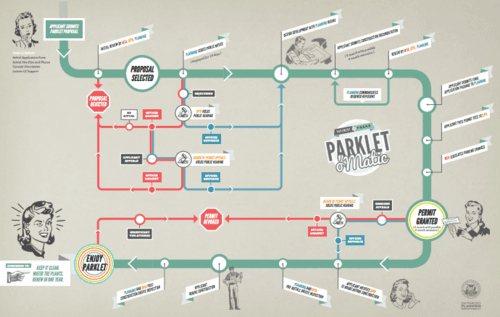
Beyond all that, the city of San Francisco now has an official “Parklet” program, which facilitates the citizen-led transformation of under-utilized public spaces into mini-parks, including this nifty Parklet-o-matic infographic:
image

This is “user-generated urbanism” at its best. And I would encourage everyone to take part in next year’s Park(ing) day, wherever you are (unfortunately, you’ll have to wait a whole year until Sept 2014). But the really interesting thing to note is the way the city (eventually) embraced this, and made space for it in their policies.

Back to 2007: at the same time, NYC was experimenting with “hacking public spaces”. That year, they began a massive program to do low cost experiments in public space transformation. The first one simply painted over an empty parking lot in DUMBO. Over the next few years, major street redesigns in Times Square, Madison Square, Union Square, the Meatpacking District, and elsewhere all over the city were started with paint and planters, not with jackhammers and concrete.

By doing these projects at super low cost, with cheap (but nice enough) materials, and by leaving the option open to change their minds if things didn’t work out, NYC DOT unleashed a torrent of public space innovation across the city. I’m not sure any established city has ever seen the level of micro-scale street redesign that NYC saw from 2007-2012. And the process of doing low-cost experiments, then collecting data and iterating was a breath of fresh air.

That’s what you might call “agile urbanism”.

So, we’ve got “user-generated urbanism” and “agile urbanism”. That sounds a lot like how we describe the evolution of the internet and the software development process, respectively. It might just be my internet centrism showing through, but it makes sense to me, and I see it continuing.

Now, in 2013, we’re seeing a new trend in our cities, which we might call “peer to peer urbanism”.

Web- and mobile-enabled peer networks are bringing “web 2.0” models of collaboration and commerce (think: Ebay and everything that followed) to every part of the city. You can now share or rent your apartment, your car, a seat in your car, your stuff, or even your dog. You can also crowd-fund public works projects, shop at virtual farmers’ markets, and start to count on new forms of peer-to-peer humanitarian aid.

This latest wave has caused more than its share of problems as cities grapple with the implications of the rapid expansion of peer-to-peer everything. It challenges fundamental notions of professionalism and trust, the same way Ebay did in 2001. For example, if I use SideCar and give someone a ride, am I a taxi driver? (the state of California just decided I’m not, but it took a while to figure that out). Does renting out my apartment on Airbnb turn it into a hotel? (New York state thinks it does).

As this continues, we have an opportunity to re-think how we regulate city activities for the public interest. I think the big opportunity is to harness the data streaming out of all of these activities and use it to enable a more permissive, but more accountable, “2.0” regulatory regime.

So, anyway, maybe this is what we mean by the adaptive metropolis. The city that changes, changes fast, and keeps on changing in response to that change. Change is good.
Systems to Cover Up Symptoms

Sep 25, 2013

Cescalouise and I have started using Wunderlist to keep track of shared to-dos (bills to pay, stuff to buy, etc). I’ve been a user of Wunderlist for a number of years now and have written about it before.

The shared lists in Wunderlist actually seem to be working for us. Whenever she adds or updates an item, I get a notification, and vice versa. This is helpful, for me at least, and can hopefully help her get less annoyed at me for forgetting things :)

I mentioned yesterday that I thought it was working pretty well, and her response was: “we’ll see. systems cover up symptoms.” Which is a fair point, I think. It’s easy for me to waste time fiddling around with a perfect system and feel like I’m making a lot of progress, while not actually changing the underlying thing (in this case, not paying attention to things as much as I should).

In this particular case I am hopeful that the system will help solve the root problem, but I guess we’ll have to wait and see.

Beyond Civic Apps: Making All Apps More Civic

Sep 24, 2013

(cross-posted on the MIT Center for Civic Media blog, the PBS IdeaLab blog, and the Harvard Data-Smart City Solutions blog)

A few years ago when I was working on the Civic Commons project with Code for America and OpenPlans, I did a presentation at Living Cities called “Cities that Work Like the Web” which discussed using open standards and internet architectures to build a foundation for open innovation.

At the time, we were doing a lot of work to advance the Open311 web standard, and had already done a ton of work around open transit data, including organizing developers to lobby NYC’s transit authority to open their data and then building out NYC’s real-time bus data platform.

My favorite story from this era is the story of how transit agencies came to adopt open data. Now, in 2013, it seems obvious that transit agencies would publish schedule, route, and real-time data in a machine-readable format for developers to build apps with. But back in 2008 & 2009, it was actually a huge struggle. There were two prevailing forces: 1) agencies not wanting to publish data at all, and going after developers who were scraping / using it anyway and 2) very slow-moving internal discussions around the development of an industry-led standard.

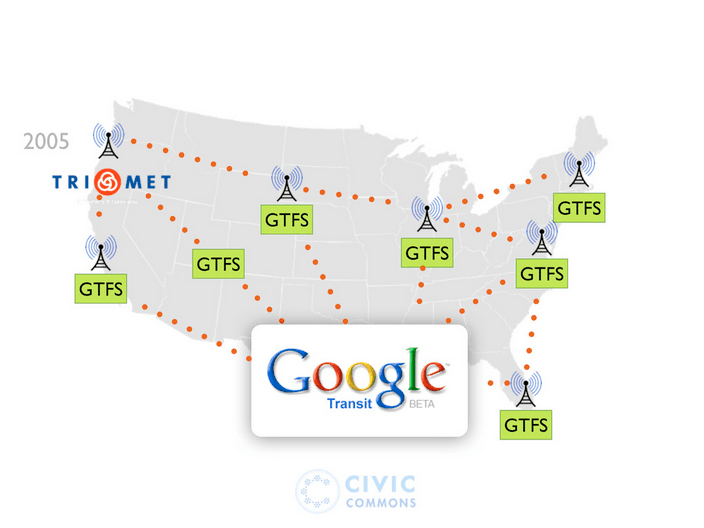
Those two forces were enough to basically keep the open transit data movement grounded. A little known fact outside the civic data world is that what made open transit data work was an outside force: Google. When Google Transit launched in 2005, they worked with Portland’s TriMet to design a new, lightweight, web-friendly open transit data spec: GTFS. That data was not only available to Google Transit, but also to anyone else who wanted to build with it.

Over time, more and more agencies began publishing their data in GTFS, drawn by the traffic that Google Transit saw. In effect, Google had created a “data magnet” — powered by their audience and by a lightweight web standard:

image

This was a tough lesson to learn but eventually more and more agencies got it: it was more powerful to have their data in Google’s app than to have visitors to their website. Or, as Steven Van Roekel, then US CIO and former FCC managing director said in 2011: “In a perfect world, no one should have to visit the FCC website.”

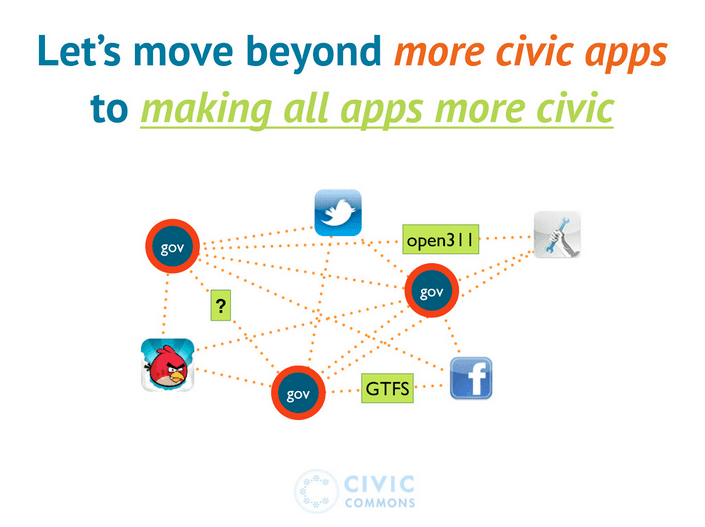
The big idea in all of this is that through open data and standards & api-based interoperability, it’s possible not just to build more “civic apps”, but to make all apps more civic:

image

So in a perfect world, I’d not only be able to get my transit information from anywhere (say, Citymapper), I’d be able to read restaurant inspection data from anywhere (say, Foursquare), be able to submit a 311 request from anywhere (say, Twitter), etc.

These examples only scratch the surface of how apps can “become more civic” (i.e., integrate with government / civic information & services). And that’s only really describing one direction: apps tapping into government information and services.

Another, even more powerful direction is the reverse: helping government tap into the people-power in web networks. In fact, I heard an amazing stat earlier this year:

http://t.co/y8HpNsFw has more potholes reported than all of the civic startups combined. @osalazar at #gpis #gov20
— Nick Grossman (@nickgrossman) January 25, 2013

It’s incredible to think about how web-enabled networks can extend the reach and increase the leverage of public-interest programs and government services, even when (perhaps especially when) that is not their primary function. I.e., Waze is a traffic avoidance app, not a “civic” app. Other examples include the Airbnb community coming together to provide emergency housing after Sandy, and the Etsy community helping to “craft a comeback” in Rockford, IL.

In other words, helping all apps “be more civic”, rather than just building more civic apps. I think there is a ton of leverage there, and it’s a direction that has just barely begun to be explored.

Personal Equity

Sep 23, 2013

There are at least two startups that I know of (Pave and Upstart) that facilitate VC-style equity investment in individuals. Upstart describes this as “the startup is you”.

In both cases, the idea is as follows: raise money from backers in exchange for a percentage of your future earnings. The idea here is that individuals, whether they are starting a company or restructuring their finances in some other way, can benefit from some amount of capital to take income pressure off of them for some period of time. That might give someone the opportunity to explore a product or company idea, or might give them the opportunity to do some other kind of life change (moving, having a child, etc.).

At USV, we were discussing this whole phenomenon a few months ago, and the general feeling in the room was that it felt a little icky to invest in individuals this way. Like indentured servitude. And that it runs the risk of striking a bad deal for those taking the cash, that they’ll resent later on.

I understand that perspective, but I think the view on this changes a lot if, rather than as an alternative to traditional equity investing / fundraising, you look at it as an alternative to debt. From that perspective, I think it starts to look a lot friendlier to the entrepreneurs / individuals.

I know from personal experience how it feels to have debt hanging over you. It’s a bad feeling (not to mention a source of chronic stress and illness), and something to be avoided if you can do it. And mismanaging debt from commercial banks is another reason why it’s expensive to be poor. But for many folks, it’s the only choice.

Personal equity, on the other hand, creates a different alignment between the investors and individuals. Everyone is bought into the individuals’ success. This is the same dynamic that makes traditional equity investing work so well.

I’m a firm believer that we are just scratching the surface when it comes using the internet to empower individuals in new ways. In finance, we’re seeing that everywhere — for individuals, in the debt (LendingClub, Prosper) and philanthropy (Kickstarter, Indiegogo) spaces, and for companies in equity (AngelList, CircleUp) and debt (Funding Circle, C2FO). Personal equity is a natural extension of that, and seems worthy of exploring.

Uber and Safer Cities

Sep 17, 2013

For some reason I have always liked talking to taxi drivers about their business. Maybe it’s because my dad was a NYC taxi driver back in the 70s, or maybe it’s because driving a taxi is such a classic immigrant path to building a life here. And it’s certainly because of the amount of tech and business model innovation in the transportation space.

Last night I took an Uber home from the airport, and was talking to the driver about his experience with it. He loves Uber — in the past 2 years, he switched from being a Boston city cab driver to being an Uber driver — and in the process traded $4000 / month in cab lease fees (what you pay a garage as a base rate to drive the cab — regardless of how much you earn) for a $700 / month car payment and $400 / month in insurance. And he gets to have a vastly improved quality of work (managing his own business & time, driving in a nicer car, etc).

Of course there are tradeoffs — if the Uber business slows down, he’s still on the hook for that car payment. And it’s possible that the number of Uber drivers will continue to increase (unconstrained by medallion restrictions, which in NYC cap taxis at 13,000), increasing competition and bringing down his margins.

But overall, he said that Uber changed his life (for the better). Not everyone feels this way, but it’s one story.

Anyway, the most interesting thing he said was not about the business, but the impact on neighborhoods. He said that Uber has radically increased the taxi / car service business in the city’s tough neighborhoods. This comes across as sounding counter-intuitive since most tech-driven transportation platforms (like Uber, Lyft and Sidecar — but especially Uber) are derided as “For Yuppies By Yuppies”. But the reason makes perfect sense: with Uber, you know your passenger.

So whereas a traditional taxi would hesitate to pick up fares in tough parts of town, because you never know who’s going to get in, Uber drivers can do this with much more confidence, since there is personal identity (and therefore accountability) built into the system.

This makes perfect sense in theory, and I’d be really interested to explore data that could test this out. Especially as NYC gears up to offer mobile payments in traditional taxis.

This is a perfect example of Regulation 2.0 — using real-time / mobile accessible data to build trust and safety into a networked system. And it points out the limitations of “1.0” regulation schemes (in this case taxi licensing), that don’t have access to such data and can hence only solve for part of the problem (in this case, protecting passengers from bad drivers). And it’s a really great example of some of the unexpected benefits of allowing new, networked models to emerge.