Half, not half-assed

Nov 22, 2014

My favorite book on product development and startups is Getting Real, published in 2006 by the folks at 37signals (now Basecamp). If you haven’t read it (it’s freely available online), it’s essentially a precursor to The Lean Startup (2011). Back when I was leading a team and running product and OpenPlans, it was like my bible. The copy we had at the office was tattered and torn.

One of my favorite ideas / chapters from the book is: “Half, Not Half-Assed”. It’s short, so I’ll just include the whole thing here:

Build half a product, not a half-ass product
Beware of the “everything but the kitchen sink” approach to web app development. Throw in every decent idea that comes along and you’ll just wind up with a half-assed version of your product. What you really want to do is build half a product that kicks ass.
Stick to what’s truly essential. Good ideas can be tabled. Take whatever you think your product should be and cut it in half. Pare features down until you’re left with only the most essential ones. Then do it again.
With Basecamp, we started with just the messages section. We knew that was the heart of the app so we ignored milestones, to-do lists, and other items for the time being. That let us base future decisions on real world usage instead of hunches.
Start off with a lean, smart app and let it gain traction. Then you can start to add to the solid foundation you’ve built.

This is so important and also so hard to do. Despite having appreciated this idea since 2006, and having told it to others countless times, I still have not mastered it, and still find myself falling in love with features and ideas that really just end up diluting my efforts.

I’ve been thinking about this because last week I had this exact advice delivered to me on two separate occasions, regarding two things we’re building at USV; once from Brittany and once from Fred. In both cases they were right, and the advice was important and helpful.

So, there it is. Nearly 9 years later, still important and still helpful, still cleverly-titled :-)
I agree with Ted Cruz: let’s supercharge the Internet marketplace

Nov 13, 2014

There has been a lot of debate about how to protect Internet Freedom.

Today, Senator Ted Cruz has an op-ed in the Washington Post on the subject, which starts out with an eloquent and spot-on assessment of what we are trying to protect:

Never before has it been so easy to take an idea and turn it into a business. With a simple Internet connection, some ingenuity and a lot of hard work, anyone today can create a new service or app or start selling products nationwide.
In the past, such a person would have to know the right people and be able to raise substantial start-up capital to get a brick-and-mortar store running. Not anymore. The Internet is the great equalizer when it comes to jobs and opportunity. We should make a commitment, right now, to keep it that way.

This is absolutely what this is about. The ability for any person — a teenager in Des Moines, a grandmother in Brazil, or a shop owner in Norway — to get online and start writing, selling, streaming, performing, and transacting — with pretty much anyone in the world (outside of China).

This is the magic of the internet. Right there.

By essentially a happy accident, we have created the single most open and vibrant marketplace in the history of the world. The most democratizing, power-generating, market-making thing ever. And the core reason behind this: on the internet you don’t have to ask anyone’s permission to get started.

And that “anyone” is not just the government — as we’re used to asking the government for permission for lots of things, like drivers licenses, business licenses, etc.

In fact, more importantly — “anyone” means the carriers whose lines you need to cross to reach an audience on the internet. A blogger doesn’t have to ask Comcast’s or Verizon’s permission to reach its subscribers. Neither does a small merchant, or an indie musician or filmmaker.

Contrast that with how cable TV works — in order to reach an audience, you need to cut a deal with a channel, who in turn needs to cut a deal with a carrier, before you can reach anyone. It is completely out of the realm of possibility for me to create my own TV station in the Cable model. In the Internet model, I can do that in 5 minutes without asking anyone’s permission.

What we don’t want is an internet that works like Cable TV.

So I agree with Ted Cruz — his description of the internet is exactly the one I believe in and want to fight for.

But where I think he and many others miss the point is that Internet Freedom is not just about freedom from government intervention, it’s freedom from powerful gatekeepers, who would prefer to make the internet look like Cable TV, controlling and restricting the mega marketplace we’ve been so lucky to take part in.

Let’s not let that happen.

p.s., I would encourage any conservatives pondering this issue to read James J. Heaney’s powerful and in-depth case for “Why Free Marketeers Want to Regulate the Internet

This is what an Internet Candidate looks like

Oct 23, 2014

I just donated to Christina Gagnier‘s campaign for congress.

I’ve gotten to know Christina recently, and I really hope she’s able to pull through this race and make it. We need smart people in DC who understand technology, tech issues, and tech policy. She is without a doubt one of those people. She’s an entrepreneur and tech lawyer who knows these issues cold and has lived with them for a long time.

Smart DC consultants have told me that Christina is too far behind to win. I’m not sure if that’s true or not. But what I know is that she “gets” technology and tech policy. And she’s not coming at it from a Silicon Valley perspective — she’s representing California’s 35th District, in the eastern part of LA county, where big technology companies are not the center of the economy, but technology is what is going to connect and power the local economy. Further, Christina has been out in the community nonstop for the last few months, including her Bold Ideas RV Tour over the last month, and I suspect the race will be closer than people think.

Christina gets that privacy and trust are central issues, that we need open networks and broadband infrastructure, and that issues like patent trolls (and software patents more generally) are hurting the tech-driven economy.

So, for those of you looking to make some last minute noise / contributions, I think Christina’s campaign is a great place to do it.

Disgusting

Sep 29, 2014

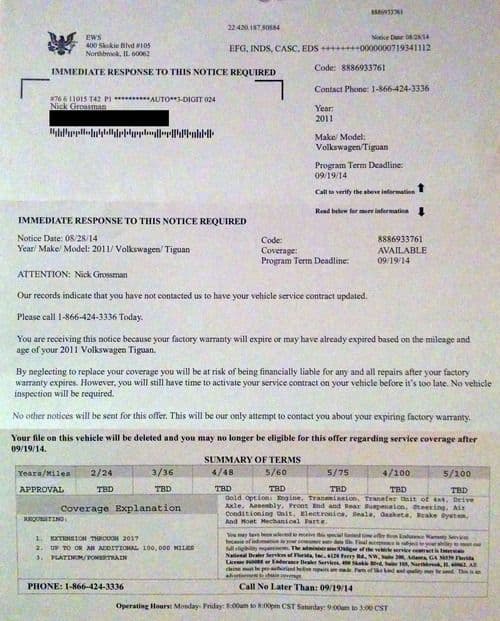
I got this in the mail:

image

It’s an ad for an extended warranty, disguised as an urgent extension of existing coverage.

This makes we want to throw up. A business blatantly based on tricking people.

“Immediate response to this notice required…. Our records indicate that you have not contacted us to have your vehicle service contract updated.”

image

Implying that I have an existing service contract with them.

My wife saw this and thought it was something we neglected and needed to pay right away. Imagine if you were 80 years old.

“immediate response to this notice required”:

image

In the tiniest print on the page: “this is an advertisement to obtain coverage”:

image

The disgusting company behind this is Endurance Warranty Services:

image

Remind me and anyone I ever come in contact with never to do business with them.

Becoming a leader of men

Sep 4, 2014

In terms of leadership, I’ve done some hard things. Building teams, reorganizing a company, dealing with failure (and success), letting people go, navigating competition, etc.

But I suspect all of that will pale in comparison to what’s up next: this weekend I begin my career as a little league coach. Starting Sunday, I’ll be leading a troupe of 5, 6 and 7 year-olds (including my son) on a journey to understand and enjoy the game of baseball.

I’ve been thinking a lot about all the coaches I had growing up, especially when I was really little. (I didn’t start playing baseball until I was 8, which is pretty different than 5, so I don’t have any direct comparisons to go on for this). The more I think about it, the more I respect the coaches I had as a kid. In particular the volunteer dad coaches (including my own) who had never done it before, and probably had no idea what they were doing either.

I’m really excited and also nervous. As much as I played baseball as a kid, I honestly never really thought about it from the coach’s perspective. From fundamental things like “hmm, what actually happens in a baseball practice” and “what are you actually supposed to teach 6-year-olds about baseball” to more subtle things like “how do build a good ‘bench culture’ that is lively and supportive”. So there is a lot to figure out.

Not to beat a dead horse about the Internet being awesome, but already I’ve started to find some help online. For instance, as Theo and I have been watching more baseball recently I’m realizing how actually complicated it is, and one question in particular has been tough to explain: force outs. So I googled “how to teach kids force outs vs tag outs” and lo and behold I came across an excellent post on teaching the difference between a force out and a tag out, from a blog on teaching baseball to kids (with the tagline “Read how I fail so you don’t have to”). Thank you Internet!

So, off I go. If anyone has any tips on being a good coach and building a good/fun team — in general or for tiny person baseball in particular — I would love to hear them.