A few months ago, I did a short interview for the Engadget Show on the state of real-time bus information here in NYC. The interview was for a video segment which led into a live interview with the reporter I worked with, Rick Karr. The whole episode is now available online. Before our section is an interview with Nicholas Negroponte, talking about OLPC and visions for the future.
35 min into the show is our part. We’re standing right outside of Penn Station, checking out the real-time bus information that’s available now on 34th Street via dynamic signage. We talk a bit about the current state of real-time on NYC buses and the challenges that the MTA has faced getting real-time implemented thus far. In the live interview, Rick mentioned some of the work we’ve been doing at The Open Planning Project, including the iPhone-based OpenBusTracker experiment we did last summer, and our general belief that real-time can be implemented for less than you’d expect using commodity hardware and open source software.
Of course, it’s tough to watch yourself on video, and it’s even tougher to hear your own edited answers. Note to self: work on snappier soundbites! But it was really fun doing the interview, and great to get the real-time transit discussion out there to a wider audience.
Thank you so much to everyone who helped us think through our re-name of TOPP Labs yesterday. Your feedback and insights were absolutely invaluable to our process.
After a long night and day of deliberations, we’ve settled on our new name. Drumroll please… (and this is obviously unnecessary since it’s in the title of the post)
Civic Works
T-shirt goes to fkh for the winning suggestion. Thanks Frank! Hat tip to Peter for getting close, with “Civic Code Werkz” and “Civic Alpha Werkz.” And I already gave a t-shirt to Noel for finding a way to make “The AWESOME” work as an acronym. I’m sure someone will find another use for that one someday.
I’m very excited about the new name, as it definitely embodies what we’re doing and why we’re doing it. We clearly wanted to include the term “civic,” and I really like that “works” has the triple meaning of “the place where things get made,” “the things that get made” and stuff that “just works.” It evokes the public realm and public service, and gets you excited to go out and make something. It’s a factory for new ideas, and the foundation for a new civic infrastructure. Civic Works. Ahh.
Of course, it’s not without precedent: this Civic Works is an AmeriCorps program in Baltimore, and, as Phil pointed out, it’s reminiscent of GovWorks.com and the movie Startup.com. But that’s OK. We’re not planning to promote Civic Works as a standalone brand as we (kind of) did with TOPP Labs. Instead, it will exist primarily as an internal division here at TOPP, and we’ll focus our branding efforts on the products and initiatives that Civic Works produces. For that reason, we intentionally left “open” out of the title, as Civic Works will almost always appear in the context of The Open Planning Project, whereas our projects (such as OpenTripPlanner) and initiatives (such as OpenMuni) will stand on their own.
So thank you again for the fun day yesterday name-storming. Next time I need to name something, I’ll come to you first.
For the past year or so, the group at TOPP that I manage has been known as TOPP Labs. TOPP Labs was originally chosen not because it was the best or most compelling name, but because as we were dialing back work on the OpenCore project, we needed a name that was better than “The Team Formerly Known as OpenCore,” or “Non-geo TOPP” (since OpenGeo is TOPP’s other main software group). Without a whole lot of thought, we settled quickly on TOPP Labs, as it was better than nothing and it generally evoked the spirit of experimentation and innovation we were hoping to embody after working for a long time on a single, large project.
Since then, TOPP Labs has come a long way. We’ve re-imagined ourselves as an incubator for new enterprises and initiatives that make cities work better, and have taken off down several paths: information systems for public transit (under the OpenGeo Transit brand); tools to facilitate citizen engagement, such as FixCity and Community Almanac; and initiatives to help public agencies get on board with “open,” such as Open311, OpenMuni, and the NY Transit Data project. We’ve been busy connecting with the open government, open cities, and progressive planning communities, and have been documenting our progress on our blog, The Civic Hacker.
But now, the time has come for us to choose our grown-up name. This was spurred in large part by our new Executive Director, but I fully agree that the time is come, and that we should have a name that does a better job describing what it is that we do, and perhaps more importantly, what we can offer. As I’ve written before, I’ve always been conflicted about the “TOPP” acronym, as it’s not self-evident what it means, and of course the same goes for TOPP Labs.
Of course, I’m not just writing this for my own good, I’m writing because I need help. Please help me choose a new name for TOPP Labs. Let’s make it a good one. Thank you in advance for your thoughts here. To help this along, here are a few things that should inform the choice of a new name:
First, what we’d like the name to evoke:
Technology, innovation, and creativity
A strong commitment to civic issues and the goal of making cities work better
A serious, competent organization that can deliver quality products & services
Second, here’s what we’d like to avoid:
Terms or phrases that could easily become cliche or dated (for example, Labs, or e, or i)
Anything that sounds overly silly and not business-y enough (e.g., the Super Awesome Group)
Anything that sounds overly business-y and not creative enough
Open Abuse — there’s only so much “open” people can handle
Lastly, it should be informed by the things that we actually do, such as:
Find opportunities for software and technology to help make cities more livable, communities more engaged, and government more effective.
Develop open source software products that accomplish the above, selling our services to government agencies, foundations, and other partners.
Cultivate communities of open source developers and other civic technologists.
Help liberate data for the public good.
So far, the strongest contenders for names have been something like the Civic ____ Group, where the blank is “tech,” “dev,” “data,” or something similar. I’m not opposed to those approaches, but I still haven’t fallen in love-at-first-sight with a name, which I’m hoping is still in the cards.
Other names I’ve noticed lately that I like are the Office of New Urban Mechanics, which is Boston’s new office for civic technology innovation, led by their innovation director, Nigel Jacobs. Also, I dig John Tolva‘s title at IBM of Director of Citizenship and Technology. We could go the city-analog route and name ourselves the Department of Public Networks or the Department of Civic Hacking (I could be Commissioner), but that’s almost certainly too cheeky.
So, that’s where I’m at. The clock is ticking, as I need to make a decision by the end of the day tomorrow, Friday 2/19.
At work recently, we’ve been exploring the idea of integrating voice and/or SMS into our applications. Much of what we do has to do with people responding to their physical environments — their neighborhoods and the streets and public spaces that constitute the bulk of our public experience.
So, I decided to take on a small weekend project, to experiment with voice and SMS. There are several tools that help you do this, including Mobile Commons, Tropo, and Twilio. For my first experiment, I chose Twilio, as the start-up process was really easy and they have a super well-documented API. Twilio claims that you can get a voice/sms app up and running in five minutes.
Here are the project goals I was shooting for:
Something that can be done over a weekend, ideally in a small enough amount of time not to piss off my family.
Something simple and useful.
Something that demonstrates the power of connecting a phone experience and a web application experience, seamlessly tying the two together.
Something that takes advantage of the native capabilities of a regular phone. In other words, something that wouldn’t be better implemented on a smart phone.
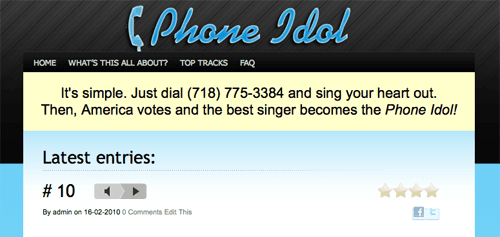
As the result of this experiment, I’m proud to present Phone Idol, a phone-based online singing competition. You know, kind of like that other idol thing, but using a phone and with no big prizes.
Then, America votes, choosing their favorite tracks through online rating
Looking back at my project goals, I’d say this definitely accomplishes #1, #3 and #4. It was done quickly, using just the Twilio API and a simple WordPress install, it demonstrates the power of connecting phones to web apps, and it works well using a regular phone. However, it’s definitely not what I would call simple and useful. But it was fun to make, and has spurred some more thinking about what’s possible here.
In the spirit of a weekend project, here are the things I didn’t do, but that I think would be cool:
Identities and account management. Right now, all I know about each submitter is his/her phone number, which I don’t want to publish. I am intrigued by the idea of web accounts that are bootstrapped and managed by phone only, not email. One of the next features I want to build is to connect submissions to online identities. This would be easy to accomplish by creating user accounts based on phone numbers and sending a text with credentials, and could easily connect to existing social networks. I admit that without this, the site is much less fun than it could be.
Content management. Right now, there’s very little meta data associated with each entry. For example, I would like to include the name of the person who submitted it, as well as the title of the song. Given the phone as an interface, this is bit tricky to manage, but not impossible. Two ways this could be accomplished: 1) after submission, send the user a text asking them to respond with their name and the title of their song. This approach would either require multiple texts (expensive) or a special syntax; 2) text the user a login link and their credentials (see Account Management, above) and ask them to log in and update their submission with details. Neither of these approaches is perfect, and I’m sure there are other alternatives I’m not considering. However, doing at least something would definitely be possible.
More social integration. This could be huge on Facebook. For now I just have standard Facebook and Twitter sharing links, but I could imagine maybe trying for deeper Facebook integration, maybe as a Facebook app. Out of scope for a weekend project, but maybe worth doing.
And here’s a little bit of info on how it’s wired together:
Twilio is configured to route calls to (718) 775-3384 to a script at Phone Idol, which produces TwiML, the markup language that serves instructions to Twilio. You can see the XML output here.
These scripts are written as a WordPress plugin, so that after the final step in the Twilio workflow, the response data (most importantly the URL to the recording) is posted to WordPress as a new post. Given more work on account and content management, as described above, I’d make more use of the WP API.
I always have a hard time explaining what we do at The Open Planning Project. The front page of our website reads: “TOPP is a catalyst. We empower civil society through software, media, and smart urban policy.” While this makes sense if you think about it for a while, when I first say it to people I’m usually met with blank stares. I don’t mean to dig on TOPP — a lot of effort went into writing that tagline, and believe me, earlier versions were more abstract and less punchy.
Prior to this current version, we had a different tagline: “Virtual tools for real-world change.” That’s what our t-shirts still say on them, and I don’t mind it. It has a skyline above it, implying a connection with cities, which I like.
But still, I don’t think we have a compelling enough elevator pitch — a description that doesn’t take five minutes and a walk-through of our org chart to explain.
So recently, I’ve been trying out something new. I’m experimenting with the following explanation:
(standard disclaimer) “We’re a non-profit software company; yeah, it’s a bit strange, I know.” “We build software that makes cities easier to use. You know, like, making it easier to get around, to interface with your government, and to connect with your neighbors.”
This morning, I tried this on a friend at the gym, and I got an “Oh, cool! You mean like public transportation? My friend in Seattle was telling me about GPS on buses there — how come we don’t have that in NYC?” Bingo.
So, I’m going to test this out a little more. Making cities easier to use. I like it. I just updated my twitter description with that; we’ll see if anyone notices.
To get a little more specific, here are some of the questions I think we’re trying to answer that fall under this larger goal:
How can we make it easier to…
get around? (ideally by foot, bike, or transit)
interface with government? (who reps me? who supports me? how can I help? how can I be heard?)
connect with neighbors? (who lives on my block? what do we have in common? how can we help each other?)
be involved in shaping the future? (combining the two above: connecting with neighbors and interfacing with gov)
Of course, there are plenty of other ways to make a city easier to use, that lots of creative projects (many of them NYC-based startups) are already addressing:
organize a team to make something happen, right now (Groundcrew)
find people who want to do things I want to do (Meetup)
and on and on…
Given all of these questions and more, it’s highly likely that Making cities easier to use is still too broad; but there’s no question that it’s easier to explain, which is a start.
And for those of you struggling with similar issues of tagline-choosing, see Seb‘s brand-spanking-new conjoint.py decision-making tool, which OpenGeo has been using recently during its own tagline discussion.
// Photo of crumpled city map by Emanuele Pizzolorusso via MoCo loco