Creativity and Free Culture

May 27, 2012

This morning started out in such a great way. I’m on a mailing list at the Media Lab called “awesome”, and this morning Kasia Hayden sent around a link to this incredible piece of creative work:

It’s a marriage proposal presented as a “live lip-dub” of Bruno Mars’ “Marry You“. Basically a live music video, staged on a quiet street in Portlandia, from the back of a slowly moving car. I watched probably 10 times today and it still brings a big smile to my face. It’s an incredible, touching, creative work, pulled together by a large cast of friends & family. It’s really something. And in the past few days, it’s been viewed a combined 2,000,000 times on youtube and vimeo.

Of course, this made be think of copyright. First, I realized that part of what I liked so much about the video was the large-group choreography in the streets. It reminded me of something, but I couldn’t remember what. Then I remembered: the awesome scene in Ferris Bueller’s Day Off when Ferris sings “Twist and Shout” on a parade float in downtown Chicago and everyone in the city starts dancing. This part is where it gets really good (it should start at the right place, but if it doesn’t, skip to 2:25):

This raised two issues for me:

  1. Is the wedding proposal fair use under US copyright law? Or is it infringing?
    I’m not an expert on this, but my read is that it’s not fair use and therefor is infringing. Who knows if the creators cleared the rights to the song, probably not. But this is a) such awesome creative work and b) nothing but positive towards the brand and market awareness for the song itself. Even if you don’t believe this should count as fair use, it’s the kind of thing where a more accessible / understandable rights clearing & licensing system would really make things easier and foster more creativity like this.
  2. I’m pretty sure the Ferris Bueller clip is infringing.
    The first clip I found of the Twist & Shout scene was here, but the actual Youtube clip had been killed, serving this notice:
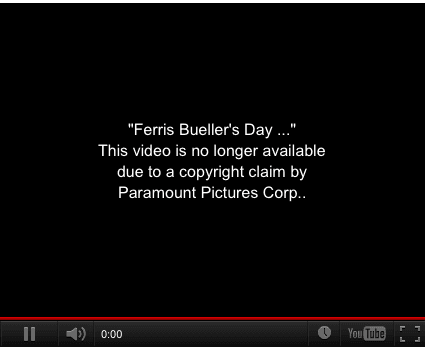
  1. I was able to find the clip I included above, but I assume that might disappear at some point as well. Which is unfortunate, because as matter of culture, it’s really helpful to link to clips like this. I don’t know if there would be a reasonable way to provide the raw material (the way that youtube does, sort of) which would, under current law, facilitate fair use while limiting non-fair use.

Regardless, this video made my morning, and reminded me of something that Eben Moglen said last week at #f2c:

“The way innovation really happens is that you provide young people with opportunities to create on an infrastructure which allows them to hack the real world and share the results”

Here’s to that.
Corruption: Make it your #2 Issue

May 25, 2012

Continuing my series of posts on this week’s Freedom to Connect conference, here is Larry Lessig‘s closing keynote.

It was a big thrill for me to see Larry deliver one of his trademark presentations in person. I remember the first time I saw one online: his Free Culture introduction from OSCON 2002. That was my first introduction to copyright as an issue and I remember being amazed at both what an interesting topic it was and at how engagingly Larry delivered it (he was the pioneer of fast-moving, slide-per-word presentations). Both the substance and style have been big influences on me.

Larry has moved on from Copyright and Free Culture as core issues. In roughly 2007, after fighting the copyright fight for years, he came to realize that the fundamental problem preventing progress on copyright — and on every other issue confronting us — was corruption in government. The fact that policy and politics are moved by money, not by people. He sees this as the root problem, and is channeling all of his efforts through his new organization, the Root Strikers.

I really like the way he’s presenting his case: that everyone doesn’t have to take on money-in-politics as their first issue, but it should be their second. In other words, focus on whatever primary issue moves you, but realize that this problem affects everything, and keep it as your #2 priority. I think this is a clever framing, and it really works for me.

So, I would encourage you to watch this video — it frames “the war against community broadband” as the first issue, backed by corruption as a underlying theme.

Kudos to David Isenberg for putting on a great event this week — I really enjoyed it, and having Larry as the closer was a great finish.

Step Number One: Internet Access

May 24, 2012

In the spirit of posting highlights from this week’s Freedom to Connect conference, I’d like to next point to the talk given by former FCC chairman Michael Copps, entitled “Step Number One to Getting our Democracy Right”. Here’s the video:

The full text is here, and it’s probably a quicker read than a watch.

Here’s the part that really rang home for me (emphasis mine):

broadband is indeed the front-and-center infrastructure of the Twenty-first century. It is dynamic and opportunity-creating to an extent greater than any of the nation’s numerous earlier infrastructure challenges. It is part of the resolution of almost every big problem confronting us: creating jobs, making America more competitive in the global market-place, providing better health care, decreasing our energy dependence, stopping environmental degradation, educating ourselves and our children and grandchildren, and opening the doors of equal opportunity to all.
But let’s remember that earlier generations had to respond to infrastructure challenges, too. Turnpikes, roads, bridges, harbors, canals, railways, highways, and electricity. Not to mention plain old telephone service, too—these were all infrastructure build-outs. Each one of them was a huge challenge in its own time. And each one of them helped jump-start the economy; each one created thousands of jobs; each one contributed to making our people more productive and our country more competitive.

This was a major theme of Freedom to Connect and I totally buy it — fast, open, equal access to the internet is a foundation for everything else. For education, and for nearly every aspect of our economy (now and certainly in the future). It is some of our most important national infrastructure. And we’re not keeping up. To keep quoting Copps:

the Internet was invented here and got its start here. Fast forward 11 years later and we’re Number 12 or 15 or 20 in the world. Some would quibble about which ranking is correct—but none of them is anywhere close to where your country and mine needs to be. I don’t say this because I want us to be able to pin a ribbon on our chest and tout our number-one status. I say it because we’re not coming back—America is not coming back—unless and until we get this infrastructure right.

So, the question is, how do we do it? This is the trillion dollar question. Copps’ full remarks are worth a read to get a better handle on the philosophical, political and economic context. Can local communities step up to fill the gap? (Last year, North Carolina said no). Will disruptive innovations catch fire, bypassing our gridlock? I am still struggling to wrap my head around the politics and economics of all this. So I don’t have a fully formed perspective yet. But one thing is undeniably clear: this is really really important. I’ll close w/ one more selection from Copps’ talk:

We have available to us the most open, dynamic and opportunity-creating technology ever devised, but its wings are clipped. Less and less are a thousand points of invention and innovation controlling out technology future, while more and more the models of consolidation and bottle-neck control are. This is not to deny the many good things happening out there, but it is to note that the system we have is making it harder for those good things to deliver their full potential. The struggle for an Open Internet is a new chapter in a very old story. It’s the story of gate-keepers and toll-collectors who have always been there when new technologies or businesses come along. Again, that’s something we should expect. It is also something we need to avoid. To put our heads in the sand on this one would have serious long-term consequences.

This is it — we need to understand and communicate the importance of and potential for this medium. The big takeaway for me, in terms of framing, from both Copps’ talk and Moglen’s, is that there’s a very clear message to be made about innovation, competitiveness and the economy, and that’s where I’ll be focusing my attention.

Innovation Under Austerity

May 23, 2012

Yesterday at the Freedom to Connect conference, Eben Moglen delivered a fantastic talk entitled “Innovation Under Austerity”. It’s about an hour long and is really worth the watch.

Eben lays out, in clear, compelling terms, the case for open, decentralized, bottom-up innovation as the clearest way for us to address the big and increasingly complex challenges we’re facing in the world today. We have the opportunity to deliver the world’s knowledge to everyone, everywhere — and at the same time to unleash the most powerful force for positive change possible: our own creativity. Eben’s main purpose of the talk is to introduce innovation as the frame for convincing our leaders to support an open Internet — that makes sense to me, and his talk should give advocates for the open internet a lot to go on in this direction.

I also want to point out one idea that really stood out to me: about halfway through, Eben hits on the important role that autonomy plays in the facilitation of innovation. I never thought about autonomy in much depth before, but Eben lays it out as one of several forms of privacy (the others being secrecy and anonymity) that directly enables creativity and innovation.

Think about it like this: cities have always been places of great creativity and innovation. A large part of the reason for this is that, in cities, people are able to escape “the surveillance of the village” and “the social control of the farm” (in Moglen’s words) — and experiment with “new ways of living”. This is possible because cities give people the ability to be alone among the masses — while at the same time being together with others who share their interests. They are able to escape (or temporarily divert from) the identity and context of their life, and explore new things without fear of social consequence. They are autonomous, and that breeds innovation. If you think about it, it makes perfect sense.

And the Internet is the same way — the old adage that on the Internet, nobody knows you’re a dog is a big deal. The ability to be who you want to be, where, and when and with whom is a great part of the freedom of the net — it’s part of what drives community, and it’s a part of the foundation for innovation. It’s easy to buy into the idea that real names are the foundation for civic discourse, when in fact history tells us the opposite. If we’re not careful, we run the risk of enabling a total surveillance environment in the name of stability and progress — and Eben’s point is that we should use innovation as the frame for steering a different course.

There is so much more I could dig into in Eben’s talk, but I’ll leave it there for now. For anyone who is interested in innovation, the internet, free culture, and “nerd politics“, this is a must watch.

cibi.me

May 18, 2012

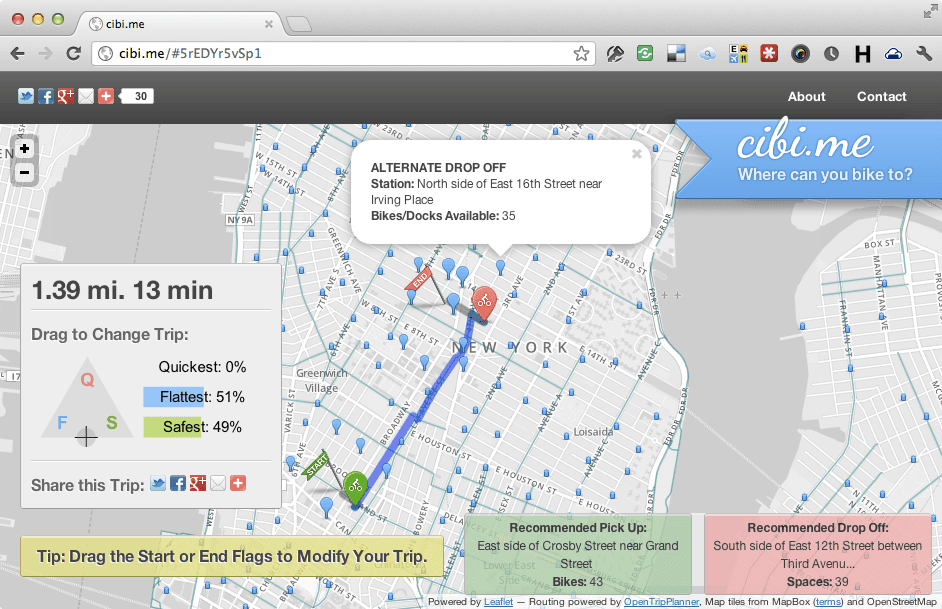
The Civic Works team at OpenPlans just launched another sweet micro-site: cibi.me — for NYC’s forthcoming bike share program.

The site is notable for a few reasons:

First, it’s beautiful and fun to use. The OpenPlans team has been putting out a ton of these small, beautifully designed and really fun sites recently (see change.st, beautiful.st), including the NYC Bike Share location suggestions map that got thousands of suggestions when it launched last year. A lot of the functionality you see here has been built into the open source Shareabouts app.

Second, it’s built on top of the OpenTripPlanner — OTP is an open source, multi-modal trip routing engine that OpenPlans has been working on for a number of years now; originally built for the new TriMet system map, it’s also been used in several other countries. Cibi.me represents one of the more creative ways to use OTP — as an API which the site talks to via JS. OTP lets you do awesome stuff like use the “bike triangle” to prioritize between safety, speed and flatness. (note that this feature was originally developed by David Emory for the Atlanta A-TRAIN mobility map)

Here is Frank Hebbert’s write up on cibi.me on the OpenPlans blog.

I am really impressed by and proud of the work that OpenPlans has been doing lately. They are on fire pumping out small, but beautiful, compelling and powerful apps.