House of Cards, and newsjacking the Blackout Bowl

Feb 4, 2013

This was a pretty fun weekend for alternative media experiences.

Of course, House of Cards launched on Netflix, testing a new model of distribution, and the Super Bowl was interrupted by a 30-minute blackout, leading to a rush to “newsjack” the moment on social media.

What I like about both the Netflix move and the social media reaction to the Superbowl Blackout is that they are both attempts to deliver an experience in a way that matches the way people actually think & operate.

I love that Netflix is stripping the bullshit (false cliffhangers, false scarcity, annoying recaps) out of the show, and giving the show to people exactly in the way they like it — mainlined. Netflix knows that lots of people like to watch TV this way: they practically invented it with the DVD business, and certainly have seen it from the inside via the streaming business.

I watched three episodes in a row on Friday night. It’s good but not great, but I was still compelled to watch a bunch back to back, and am now basically hooked through the rest of the season. More importantly, I’m definitely less likely to quit my netflix subscription (as I tend to do every few months) now.

With the Blackout Bowl, it was interesting to see which responses resonated the most on social media, and which didn’t. In general, the brands that chose to make something timely & cute (pretty amazing, the speed with which Oreo created that) or say something clever rather than pimp their own ads did much better. And as Mike Masnick notes, Oreo’s quick and clever reaction on twitter may have saved their superbowl, as their TV ad was weak.

I just like — in both cases — the trend towards more authentic and net-native media experiences. It’s great to see brands experimenting with / figuring out how to go with the flow of the net, rather than fight it.

Still looking for a smarter inbox

Jan 30, 2013

I am bad at email. Maybe everyone is. But I feel like I’m worse than most; or at least worse than I want to be.

I feel like my inbox should do a better job helping me find emails that are important. I use Gmail and Priority Inbox, so I don’t mean “important” in that sense (emails from close contacts).

By important, I mean things like:

  1. Conversations where “the ball is in my court” (hard to discern programmatically perfectly)
  2. Conversations that I initiated — then the person wrote back — but then I didn’t write back to (similar to #1 but easier to identify, and more important)
  3. Emails that I have not responded to yet at all
  4. Emails from important people, where important takes into account other data such as: twitter followers (total, in common), linkedin connection, etc.
  5. probably a few other smart ways I’m not thinking of right now.

I have been thinking about this a bit after reading somewhere (I think in Venture Deals) that Brad Feld and his partners read and respond to every inbound email every day. That’s pretty impressive.

I am not there yet. But I like the idea a lot. So today I did set up a little gmail query to try and help with that:

newer_than:1d and is:important

This gives me a view of all the emails that I received in the last day. It’s a start. But it’s not perfect. It doesn’t give me is a view of conversations I have not participated in yet.

I tried adding a filter such like: -from:me, to try and exclude any threads that I’ve participated in, but that doesn’t do the trick. So I what I see is a list of all the emails that came in today, including every email I sent. Which is not what I’m looking for.

I complained about this to Fred the other day, suggesting that there’s still an opportunity to build a product (along the lines of SaneBox or Gmail Meter) that really solves the inbox problem. It’s such an important problem for so many people, and it’s still so far from perfect. His response was that there’s a fear of investing in things that are too close to the core of the email platforms. I am not sure I agree, but it does seem that there still isn’t a perfect solution, so maybe that’s the reason.

In summary, I would love to see: a) a simple gmail query parameter that lets me find conversations in which I am not yet a participant (I feel like this must exist!) or b) a smarter view of my inbox — perhaps one that is another kind of visualization besides a list — that takes into account these other important factors. I’d pay good money for that!

Update: this query is pretty good: newer_than:7d is:important in:inbox

Superheroes in the Snowpocalypse

Jan 24, 2013

Yesterday Uber made me feel like a superhero.

It was about 10 degrees in Boston, and I was on the T on my way into Cambridge. And as we pulled in to Kenmore station the conductor notified us that all Green Line trains would be going out of service. So my train — and every train before us and after us — dumped all of its passengers out into the freezing cold to find another way to get wherever they were going.

There were a few shuttle buses, but they barely made a dent in moving the crowd. Every single taxi was full. After a few minutes, there were easily over a thousand people huddling outside in the freezing cold trying to figure out what to do.

I reached into my pocked and tried Hailo, but all taxis in the area were booked. Uber gave the same response — but on my second try I was able to snag an Uber car. So: five minutes later, I got a phone call and a black Lincoln pulled up next to me. I offered to share it w/ the group of people directly next to me, but no one was going my way. So I hopped in and was whisked away from an overcrowded frozen nightmare in a warm, comfortable car.

Totally made me feel like a superhero.

But not necessarily in a “save the world” way — more of a “wow I have a superpower” way.

When I got to the Media Lab and told the story to Nate his (correct) reaction was: “well, a black car swooping in to rescue a white man is kind of the definition of privilege. Wouldn’t it be more amazing if there were a way for everyone to take advantage of the network of transportation options swirling around?” 

Of course this is correct — while I was able to snag a ride out of the ether, there was still a huge market mismatch: thousands of people standing around looking for transportation, and hundreds of cars driving by with empty seats. Yet no way to connect them.

Ride sharing is not a new idea — there is no shortage of startups working on the idea — SideCar & Lyft for car rides, Weeelz for taxi rides, etc. — but it is something that is culturally and technically difficult to implement. Lyft got its start (I think) on college campuses, where sharing rides to events is a much more natural phenomenon.

In times of crisis we are more likely to stray from our normal behavior and try new things. NYC famously mandated taxi sharing for all trips into Manhattan during the 2003 blackout and again after Superstorm Sandy. Nate and I got to discussing if there wasn’t an opportunity to use yesterday’s class of crisis — a medium-sized but somewhat predictable one — as another “thin edge of the wedge” to make ride-sharing more of a mainstream networked activity.

For instance, I’d gladly sign up to be part of the “boston transportation crisis network” — as a driver or a passenger, and basically pre-volunteer to give rides to people when this kind of thing happens again. I would like to know the number of times per year when the green line breaks down at Kenmore on very cold days — I bet it’s a lot. So there would be a decent chance of predicting it and then giving folks in the network a little bit of advanced warning.

If you think about it, weird anomaly events are perfect for launching new, behavior-changing activities. It was during the inauguration of 2009 that Airbnb got its start — by giving people a chance to “crash the inauguration” by participating in peer-to-peer apartment renting. At the time, it was *way* outside the mainstream to do something like that. But the craziness of the event made it fine, and now it’s a regular thing to do all over the world and Airbnb is a billion dollar business.

My other favorite behavior-changing anomaly is snow. My favorite place in the world is NYC in a snowstorm. Everything changes. Instead of walking on the sidewalk and keeping to yourself, you walk in the middle of the street and talk to your neighbors as well as strangers. During the Washington DC Snowpocalype of 2010, there was a lot of peer-to-peer shoveling happening.

I wasn’t in NYC after Sandy, but I have to assume that there were similar kinds of networked behavior that were positive but would have been hard to imagine under normal circumstances.

Maybe the idea is that people become more open to networked / peer-to-peer solutions when our infrastructure fails us — because they have to be.

If you think about it that way — it’s a pretty profound idea. Not to be pessimistic, but in our current environment, many of our institutions are failing. And we will have to become comfortable with other ways of solving our big problems. Health, education, energy, transportation, etc.

So maybe there’s a launch lesson in here for folks building peer network businesses that rely on cultural change that’s difficult to achieve under normal circumstances. Think about the traditional infrastructure you’re replacing — and think about the moments or events when they are most apt to fail, giving people the most natural incentive to change their behavior in ways they wouldn’t otherwise.

And give people a chance to become superheroes.
Fighting for change: why and how

Jan 21, 2013

Happy MLK Day everyone.

I just spent the last half hour reading MLK’s Letter from a Birmingham Jail. To be totally honest, I don’t think I’ve ever read it in its entirety before. It is incredibly powerful and moving. I encourage anyone reading this to take some time with it today. I pulled a few quotes here.

King’s letter makes the case — in exceedingly eloquent and persuasive terms — for nonviolent direct action in the face of injustice. And discusses the historical precedent and moral imperative for distinguishing between just and unjust laws (including a framework for drawing that distinction), and for disobeying unjust laws. It hammers home the point that we can’t blindly accept “the law” if we don’t take into account the context in which it was created or the morality and justice of the ends it seeks.

Part of the beauty of it is the guided tour of the history of changemaking, conflict and progress that Dr. King takes us on — all the way from Socrates, to the Boston Tea Party and the American Revolution, to the Holocaust, to of course the Civil Rights movement. It’s kind of incredible the extent to which we have to learn and re-learn the dynamics of societal norms and the process by which we arrive at and live under the rule of law.

At the heart of the letter is tension between a moderate “take it slow” approach (embodied at the time by the white southern church, whose leaders the letter was addressed to) and more extreme “force change now” approach (embodied at the time by Elijah Muhammed’s Muslim movement). King’s articulation of the rationale for a measured and pure — yet intentionally impatient — nonviolent approach is incredibly thoughtful and reasoned.

It’s part inspiration and part how-to for anyone working to create positive change in the face of resistance from the status quo.

I can’t equate the civil rights movement with the digital rights movement, and I won’t do that here. But that is the corner of the activism world that I sit in, so it’s the lens that I’m reading this through. And I can’t help but think about the passing of Aaron Swartz, and the path he charted in the pursuit of social justice, as I read Dr. King’s words. So many of the conversations I’ve been having this past week have revolved around this question of how we view and respond to acts of civil disobedience.

More importantly, I want to use today to reflect on both the (incredible yet entirely incomplete) progress that we’ve been able achieve as a nation since 1963 when this letter was written, and the profound and powerful moral foundation for change that Dr. King’s letter provides.

Peer Networks and Health Innovation

Jan 11, 2013

Yesterday, I went down to DC to visit the US Dept of Health and Human Services – and presented to their Innovation Council (a cross functional working group on innovation) about opportunities to bring “networked thinking” into the health space.

This is clearly such an important area, with huge opportunities for personal and societal benefit. It’s also one that has been on my mind a lot lately (both Cescalouise and I suffer from chronic conditions: chrons, hashimoto’s / thyroid cancer, mysterious blood clots; my second puberty; two small kids, etc).

In prepping my remarks, I ended up re-watching John Wilbanks’ awesome TED talk on the idea of a health data commons — a mechanism for becoming “data donors” for medical research. The talk is great.

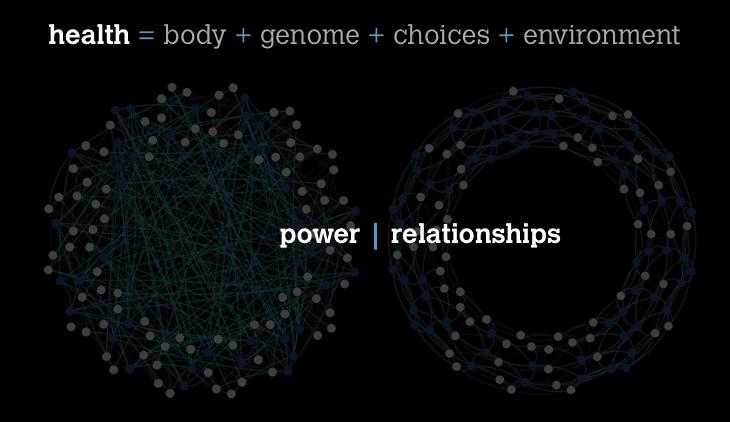
I actually ended up using an idea from Johns talk to frame my presentation, which is this:

health = body + genome + choices + environment

My talk was about “peer networks” and health — and the framing I used was that peer networks (networks of people connected via the web) have dramatic impacts on power and relationships. So, what if we look at each of these dimensions of health through the lens of how individuals’ power and their relationships to one another might change given a networked approach:

(the image in the background is from this MIT study on the relationship between peer network structure and health-related behavior changes)

The idea I came to is that these dimensions of health present a spectrum of relative challenge when it comes to applying network dynamics (largely due to the relative strength of gatekeepers and relative difficulty of using data):

  • Environment: Easiest. There are tons of network-oriented environmental health activities (like this one, a crowd-funded distributed air quality monitoring tool). And I include services like Eligible in the “environment” category, as they are collecting and making accessible “environmental” information that is already reasonably accessible.
  • Choices: Easier. There are many many startups that are working to help us make better health choices. Services like Lift, and like many of the Rock Health graduates. The MIT study linked above is just one of many that point to the potential for structured social networks to have a real impact on our health choices.
  • Genome: Harder. You can go to 23andMe and genotype your DNA for $99, but it’s not a choice everyone is comfortable making.
  • Body: Hardest. The data associated with our bodies (lab results, etc) is locked up, fragmented, and siloed. Most of the apps which are approaching the “body” space are using hacks such as manually entering your data, or taking photos of paper records). There are no shortage of electronic EMR systems (like DrChrono) that are starting to digitize more of our health records, but there are not yet any laws or standards for accessing this data broadly. Programs like the VA’s Blue Button (which HHS is working on adopting in some way) are an important start.

I also gave a brief overview of what conditions can help networks flourish. Simple, lightweight data access standards, plus a system for establishing trust among apps that manage personal health data (as my colleague Albert has written about) are central.

I’ve posted my slides to Speakerdeck here.

One question that came up in the conversation afterwards, which I don’t know the answer to, is: how has the financial sector able to achieve the level of interoperability that it has? There are a lot of parallels between personal financial data and personal health data, including many common privacy concerns, and finance is way, way ahead in terms of digital access & interoperability.

Another big takeaway for me was that I need to start using more of this stuff. I am a member of Patients like Me, but it hasn’t really been doing much for me. There are lots of other tools out there and I’m going to start trying them.