Wanted: A Dashboard for Internet Citizenship

Feb 19, 2013

One thing I’ve wanted for a long time now is a dashboard that helps me track the wide array of tech policy issues I follow.

One place where I could check, every morning, to get a sense of what issues are trending & developing, what longer-term issues are brewing, what specific milestones are approaching, and what opportunities there might be for me to get engaged.

Something akin to Techmeme + Crunchbase, but focused on policy issues.

I’ve been thinking of this as a “dashboard for internet citizenship”.

Here’s what I do, in the absence of such a thing. I read Techdirt and Ars Technica’s Law & Disorder religiously, and I keep an ever-growing Google Reader feed that tracks tech policy thinkers. And all of this is great.

But what I really want is something a bit more structured — that breaks issues down by sector & type (e.g., copyright vs. transportation vs. international, etc.), and understands things like timelines, which are particularly important with policy issues (and which are constantly changing). And I want something that spans many sources, and is peer produced and peer curated.

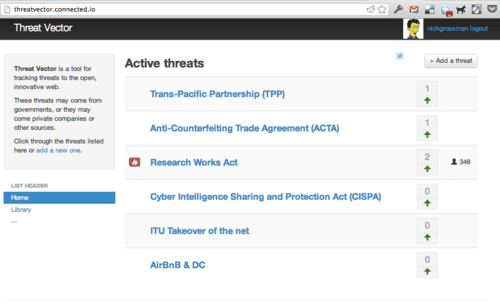
Last year, I started to prototype a take on this, which I dubbed “Threat Vector” — a simple site for tracking issues and topics, and associating them with news stories:

image

A demo is running here (code here)- but it’s been sitting in half-baked form for several months now, which is a shame.

I also spent some time last year sketching out a more involved idea for a social network for tech policy, which I could see as growing out of a simpler starting point like Threat Vector.

I really want something like this. I’ve taken a few half-starts at it, and have a ton of ideas about how it might work, but haven’t really focused on it. Maybe there is something like it out there on the web already, but I haven’t found it yet. Something like this would make a great addition to the Internet Defense League.

If anyone is interested in taking this on in some form, I’d be happy to help make it happen.

NYC Taxis and Regulation 2.0

Feb 15, 2013

This week, the NYC’s black car association (limos and car services) filed suit to block the e-hail pilot that was set to begin today.

The argument is that there has traditionally been a formal divide in NYC between taxis you hail on the street (yellow cabs) and cars you reserve in advance (black cars / limos / car services); that that divide serves an important public interest goal; and that e-hail crosses that divide.

This raises two questions: 1) why do we distinguish between street hails prearranged pickups? and 2) does e-hail actually cross that line?

I’d like to start with the first one because I think it’s more interesting.

What we have is a rule — a bright line between heavily regulated, street hail-only yellow taxis and more lightly regulated pre-arranged rides in livery cars. Why do we have that?

My suspicion is that there are good reasons why that rule was originally created — but that we now have a Regulation 2.0 opportunity — to satisfy those public interests using tools and techniques not available when the original rules were written.

So, why do we have this divide? I can think of:

  • Passenger safety – since you are hailing on the street, you need to know that you can trust the driver and car. Therefore yellow cabs are subject to greater regulation — when you call a car service you are vetting the company in advance.
  • Discrimination — yellow taxis must accept all passengers and must take passengers to any destination within the five boros.
  • Driver safety – it might be unsafe for drivers to be interacting with dispatch equipment (on a smart phone, on a radio, on some other kind of console).
  • Street safety – this is maybe a lesser concern, but roaming cabs make the city safer to walk around. They are another form of “eyes on the street”

Maybe there are others, but that’s a first pass. To take them in order:

  • Passenger safety: This seems like an argument for why black cars can’t take street hails, not vice versa.
  • Discrimination: clearly an important topic. So: does discrimination happen now? Anyone who takes a taxi in NYC would say yes — either on the will-this-taxi-pick-me-up angle, or the will-this-taxi-take-me-where-i-want-to-go angle. It’s true that taxi drivers can choose not to accept e-hails, and they could conceivably discriminate based on the first-name of the hailer (which is also happening already, just by appearance, not name). I’d argue that destination discrimination will decrease with e-hail as drivers will have to commit to the ride before they know the destination (and NYC could enforce this limitation).
  • Driver safety: taxi drivers interact with in-car tech in nearly every city already. In this case, accepting or rejecting a hail would be limited to a single button press if the car is in motion. Non-issue.
  • Street safety: I think this one is interesting, and it relates to the second question which is whether an e-hail is more like a street hail or more like a prearranged pickup.

If anything, the distinction that black cars shouldn’t be able to accept street hails seems to be more relevant, primarily for #1 above. But I also suspect that that could be solved with a regulation 2.0 approach as well.

So, on the second question: is an e-hail more like a street hail or more like a prearranged pickup? This is less of a “public interest” question, and more of a “does this break the law as currently written” question.

You could kind of argue it both ways, because clearly e-hail is a form of pre-arrangement. But so is street-hailing. Between the time the driver sees me and I get in, we are arranging the ride. With e-hail the driver doesn’t see me with his eyes, but with his phone. Since e-hails in NYC would only work within a half-mile radius of the caller, and they only work in real-time, it is actually quite a limited form of pre-arrangement and may actually be more similar to a street hail. i.e., I can’t reserve a car for a future time at a distant location.

If anything, I might argue that the e-hail revolution (including Uber which primarily focuses on black cars, not taxis) should help the livery industry as much as the taxi industry, as it vastly increases the surface area through which they can connect with customers. Web 2.0 and regulation 2.0 techniques for building trust generally work in favor of groups that traditionally haven’t been as trusted (and consequently may have been regulated out of business).

I’ll end with a money quote from TLC commissioner David Yassky:

“This suit seeks to keep the taxi industry and New Yorkers in the dark ages,” he said. “Next thing, they’ll be suing restaurants to go back to wood-burning stoves. Our rules allow for e-hail now, and the only question is, do we embrace these new services and ensure that consumer protections are in place, or listen to obstructionists and watch e-hail apps proliferate without any regulatory input.”

My hope in thinking about Regulation 2.0 is that we can use the tools we now have available (primarily: tons of real-time data) to allow for more innovation and room to experiment, since we now have ways of understanding the impacts of these changes much more quickly and in much more detail.

(disclosure: Hailo, one of the e-hail companies in question, is an investment of USV, where I work)

Living in the Fall Line

Feb 14, 2013

For the past few months I have been seeing an executive coach, which has been really helpful for me.

One of my issues is that I tend to keep too much work bottled up in my inbox / in my to do list. This is a drain on productivity and a source of stress. Part of what I’m working on is keeping things moving – through me and outside of me, and so far it’s been working.

Part of the coaching process has been sussing out *why* i tend to do this (as opposed to how, or to jumping to surface solutions). Clearly fear — of some kind — is a part of it.

One thing that occurred to me last night is that working on a lot of things simultaneously and keeping them all moving is kind of like skiing — at a certain point you have to stop fighting gravity and jump down into the fall line. In other words, point the skis down the hill, let gravity do its thing, and adapt as you pick up speed. But get moving and stay moving.

There is something in this that’s similar to being naked online. Maybe the answer is to ski naked online. Maybe I’m taking things too far now…

// image: http://bfitsandiego.com/bfit/category/fitness-locations/adventure-ski-school-encinitas

WebFWD: Accelerating a Better Internet

Feb 13, 2013

I’ve always loved Mozilla‘s mission and tactics – using awesome consumer products as the lever to make the web a better place to be.

That’s why I’m happy to join their WebFWD accelerator program as a scout. That just means that I’m one of many folks who are on the lookout for products and companies that would be a good fit for the WebFWD program.

WebFWD is a slightly different kind of accelerator — it’s not a full-court-press in-person bootcamp, and it doesn’t take an equity stake for participation. The idea is to give promising projects that advance the mozilla mission that extra boost they need to become real (or even more real).

WebFWD recently graduated its second class, and has just welcomed its third. You can see the whole list of projects and companies in the WebFWD family here.

Here’s to the continued development of products and businesses that promote openness, innovation & opportunity on the Web.

Design, Policy and Infrastructure for Great Experiences

Feb 12, 2013

I consider myself an accidental policy person.

In other words: I didn’t set out to study and understand how our policy decisions impact the world we live in. Rather, I came at it from the perspective of design and experience (both real world and virtual) and ended up backing into the policy implications, almost my accident.

This was the case both in my early career when I worked in city planning and in my more recent career in technology.

When I first started studying cities, my core interest was at the design level. What makes one building “feel” better than another? Why are some streets nice to walk along and others aren’t? What makes one neighborhood feel comfortable, intimate and vibrant, and another cold, lifeless and isolating?

My initial idea was: well, they are just designed better. As if any one person (an architect, say) had the power and vision to create a place that felt a certain way and that fostered certain kinds of activities. So I studied architecture and urban design.

What I ultimately learned was: good design is an important part of the mix, but it’s hardly enough. Given any physical place, what it “feels” like is as much a result of the policy, political and historical contexts as it is a result of the design itself.

And: it takes a whole lot of effort to align the various forces present in any project in such a way that something interesting and wonderful can happen. Take any great place, and there is no doubt a history of high drama behind how it got hat way. For instance, the streets of NYC are nicer to walk around these days because lots of people fought hard to make them that way. It takes big balls and political toughness to make these kinds of things happen.

It’s the same way with technology and the internet.

I was drawn into tech from the design side — I liked to design websites and build applications that looked good, felt good, and created a nice experiences. But yet again, that was just the entry point for drawing me — unwittingly at first — into conversations about things like web standards, open data, network architecture, copyright, patents, privacy, and spectrum policy.

It’s easy to look at the things we like on the internet: wikipedia, twitter, kickstarter, etc etc etc, and assume that they are the result of good design alone; and clearly they are the product of tremendous design effort. But they are also able to exist because of the infrastructure — both technical and legal — they’re built on.

Clearly I am drawing on my internet centrism here by using cities and the internet as examples, but that’s just what I think about. I’m sure you could look at other fields and tease out similar connections between design, experience and the underlying policies and infrastructure that make them possible.

Anyway, I guess what I’m saying is that it’s important for us not to take for granted what we have, to try and understand what it really is that makes things great, and to get upset when we feel like we’re going down the wrong path.