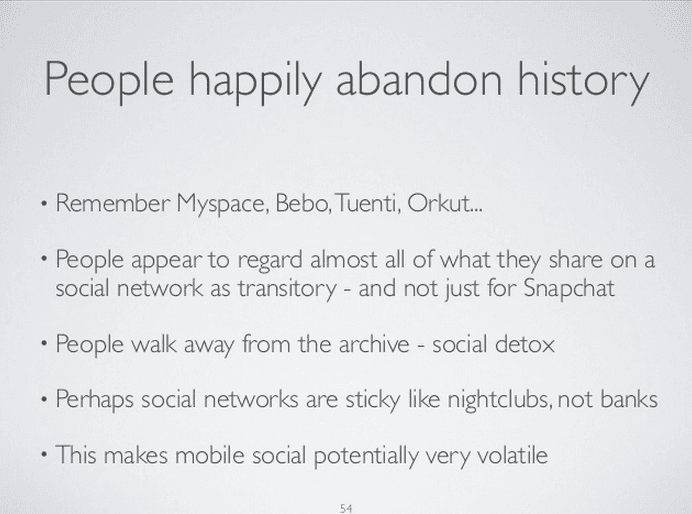
Because a lot of our social network lives at the phone OS layer (contacts), and because mobile social may be “sticky like nightclubs, not like banks”, perhaps the switching costs among mobile social networks are low.
At USV, we’ve been talking about this a lot in terms of how a network’s policies (e.g., user privacy, share of economics) relate to its ultimate ability to retain users. And the idea that perhaps the most sticky networks are NOT the ones that are the most heavy handed in terms of attempting to lock in their users (e.g., by making data export/import hard).
This would suggest that in many cases (at least in mobile / social), data lock in is less of a “lock” than you might think, and in fact, there may be something cathartic and cleansing about walking away from your data, i.e., “detoxing”.
I’ve been a remote or semi-remote worker for a long time now. Which has a boatload of pros (flexibility) as well as cons (distance from “the watercooler”).
Over time, I’ve tried lots of things to help forge a stronger connection among my distributed or semi-distributed teams. As you would expect, it’s always a lot harder in the semi-distributed context, where some people are face to face and some people aren’t. In those cases, it’s always hard to get the f2f people to adopt technology for casual chatting.
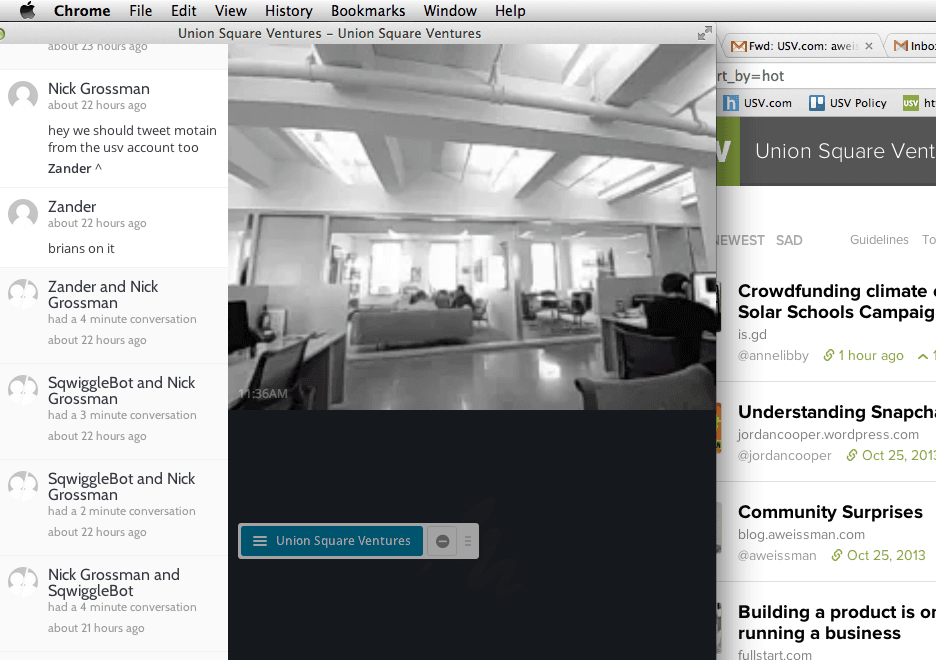
My new favorite tool for this is Sqwiggle. Sqwiggle is a chat / video service for distributed teams. My favorite feature is that, rather than seeing each person in always-on real-time video, you see black & white snapshots in 10-second intervals. This removes a lot of awkwardness. My second favorite feature is the ability to initiate a video conversation unilaterally — in other words, if I want to video with Zander, I just click on his face and start talking. No need for “ring him”. The folks at Sqwiggle like to note that this results in much more frequent, but a lot shorter, conversations (like what you get when you’re in an office together).
At USV, we’ve set up a “Sqwiggle Bot” in the office — it’s an old iMac, sitting on my desk, which is hooked up to a wide-angle camera and is persistently logged into Sqwiggle. Anyone who is working remotely (as lots of us always are), can just dial into the bot, and “poof” we’re sitting in the office. It looks like this:
From my home office, it looks like this:
You can see Zander on the right, and Fred’s and Albert’s offices in the background.
So, that’s been great, and we’re using it more and more.
The thing that is more vexing is actually a much simpler problem: Group chat.
Back when I was at OpenPlans, we were heavy IRC users. The whole team (folks spread across multiple cities, but concentrated in NYC) was always in the #openplans IRC channel, and it was the social hub of the office. And not just for remote folks — when it was time for lunch, people would ping the IRC channel. There was tons of chatting back and forth, via IRC, among people sitting next to each other. It was, and is, great.
There are a few features that make group chat in IRC awesome:
1) regular chat is unobtrusive. Meaning, you can be in a room, but not get a notification of every single message.
2) username notifications. when someone wants to get your attention, they just mention your handle, and your client bounces a notification to get your attention.
1 and 2 together mean that you can stay logged in to the channel all day long, not be overwhelmed by it, but still be directly reachable when people want to get your attention.
3) it’s hackable. Since it’s an open system, you can write all kinds of hacks. Our SVN repo was tied into IRC, so every time someone committed code, it posted to the channel. We had a bot that would reply to certain kinds of questions with silly answers. You can build whatever kinds of things on it you want.
In sum, it was (and is) a fantastic tool for staying connected with a large group.
If you were to add in persistent history and video-chat, you’d have the perfect tool.
it’s worth noting that you can do similar things with other tools. Campfire, by 37signals, does a lot of this. So does Skype.
Those are good tools, but what I’ve been looking for recently, but haven’t been able to find, is a way to get a similar experience out of Google Hangouts. The reason being that the entire USV team is in Gmail all day long, and does a fair amount of one-to-one chatting in gChat (now Hangouts). So, rather than doing the (likely impossible) work of getting everyone to use a new tool, I really really want a way to accomplish this in Hangouts, which we all already use.
What’s extra frustrating is that, until recently, you could accomplish something similar in Google Talk using Partychat, since Google talk was built on the open XMPP protocol. But with the switch from Google Talk to Google Hangouts, Google dropped support for this:
We realise Google’s migration to Hangouts breaks @partychat due to removal of XMPP federation support. We are considering workarounds… — Partychat (@partychat) May 16, 2013
If you listen closely enough, you can hear the eerie mantra “embrace, extend, extinguish” emanating from the Googleplex…
So, I’ve been trying to figure this out. And it’s been frustrating. If there is a solution out there, I’m dying to know it.
It’s fascinating to watch the process of business models exploding.
What apple did yesterday in announcing free OSX and free iWork apps is a great example of that. MS has traded on license fees for Windows and Office forever, and for a long time, Apple has followed suit, charging reasonably high (although continuously declining) prices for each.
Now, with outrageous revenues from hardware and the app store, they don’t need to do that anymore. In fact, free distribution of OSX and iWork will just expand the ecosystem and grow those revenues.
In most cases, it takes some kind of end-run and a lot of scale to make this kind of thing possible. Apple can do it now because they created a brand new channel & model with the app store, and built a monster hardware business. If they had tried, before doing that, to “reinvent” the OS business, they wouldn’t have had the leverage. It’s interesting to look at other sectors where this is happening:
* Music: Soundcloud is letting artists distribute direct-to-fans, end-running the labels and the traditional pricing and distribution model. At some point, they will reach a tipping point that will force the old model to change.
* Education: textbook publishing and open source. I don’t have examples on the tip of my tongue but I can’t wait for this one to happen.
* Law: lexis nexis & westlaw vs new platforms like Casetext.
Now that I look at these examples, they’re all cases where distribution has been expensive, and intermediaries monetized the IP directly. What we’re seeing more and more of are models where distribution is cheap/free and IP is monetized indirectly.
Last week, I traveled to SF, and ended up on a flight with no internet (aaaaaaagh!). And, of course, I forgot to bring the book I’m currently reading.
So, I went old school and bought a book at the airport bookstore. I honestly can’t remember the last time I did that. Actually, I bought two books: Gladwell’s new David and Goliath, and the Steve Jobs biography, which I still haven’t read.
Side note: ever since I saw this Louis CK clip about people not being able to be away from their phone for 30 seconds, I think about it all the time. Every time I get on a plane and find myself fidgeting and making phantom phone grabs whie trying to get through that awful time between “the cabin door is closed” and “you may now use your portable electronic devices” I think about it.
Anyway, so I was on this flight, with no internet, and I started reading David and Goliath. Which, in typical Gladwell fashion, draws a bunch of seemingly counterintuitive connections around the idea of “advantages as disadvantages” and “disadvantages as advantages”. Showing us the limits of power, and in particular, the strength of creativity in face of power.
Being in the startup business (now), and coming from the open source software business (then) and the advocacy business (then), and as a disciple of Jane Jacobs and Holly White, you’d think I’d have a basic handle on this idea, as you could argue that it’s the single strand that runs through everything I’ve worked on for the past 15 years.
But still, I find it to be a really useful frame. I can’t tell you how many times in the past week the idea of “competing on a vector they can’t compete on” has come up. That is all about David and Goliath. If your competition is a super well-financed startup player, or an industry giant like Google, you can’t expect to take them head on, play them at their game, and win. You have to think about what you can do, that they can’t (or won’t) and press on that angle.
And, from more of a personal perspective: it’s easy to get hung up on present-day challenges (financial, family, social, safety, etc.). For instance, I’ve written before about growing up scared in NYC, and how that defined an era for me and left a big scar, but ultimately (I think) helped shape my perspective in a positive way. And there are plenty of other things I can think of that have been, and continue to be, hard.
So overall, I find the “disadvantages as advantages” frame to be super useful (critical, possibly), and will no doubt keep it in the back of my head for some time.
I’ve been thinking a lot about this idea of being organized vs. being disciplined. It’s easy to want to “get organized” — or worse, to spend a lot of time and effort getting organized — but then not actually have the discipline to see it through (this is also known as “systems to cover up symptoms“).
Framing the question this way has lead me to ask myself, when trying to improve on something, if I’m being disciplined here, and if the answer is no, then why not. Inevitably that leads to a more profound answer than “well, I just need to get more organized here”, which often results in yak shaving, procrastination, and a false sense of accomplishment.
I am thinking about this — if it’s not obvious already — because my natural tendency is to do the opposite. And it seems clear to me that this is not usually the best way to be. For example:
* “ooh, I really need to get in and set up mint / check / etc to help me manage spending and bills (vs. spend carefully and simply keep track of what’s due / paid and/or set up a regular time to do it)
* “if only I had a better way to find important emails I haven’t responded to yet” (vs. set aside a regular time every day to catch up on important emails)
* “gosh, there are so many issues to keep track of at work; let me build a web app to keep track of them all” (vs. stay more on top of my email!)
* boy, it sure would help to have a better way to share our to do list at home (vs., say, pulling my head out of my phone when I’m at home).
* and on and on and on
In my own defense — I do think part of what makes me effective as a technologist is that I like thinking about and building products and systems. I try lots and lots of products (often out of this quest to be more organized), and I think that’s helpful in terms of understanding what’s out there, how things work, etc. And I love hacking on stuff. That’s fun, and useful (I hope!), and I don’t want to stop doing that. But a healthy dose of discipline can’t hurt.
As I look at these examples, it strikes me that establishing a routine would help with a lot of them. Now, if I could only find a way to help me track all the areas where I want to build a routine…